17th March, 2026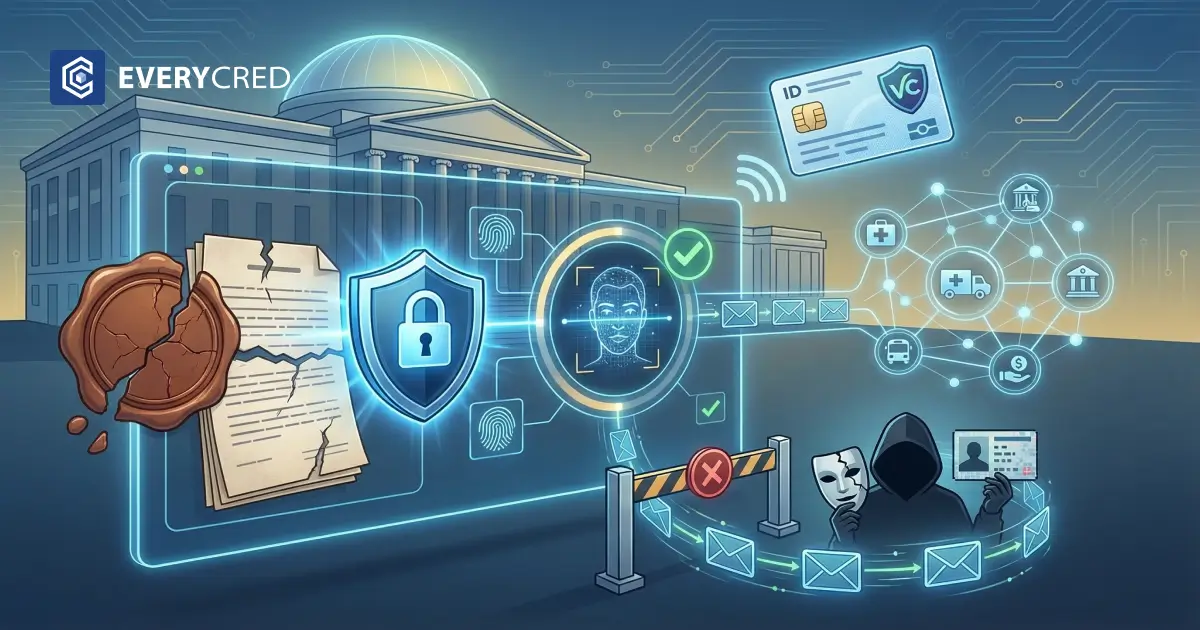
- Why Are Legacy Onboarding Systems Costing Government Agencies Billions?
- What Are the Mandatory Specifications for Modern Procurement?
- How Does Liveness Detection Defeat Synthetic Identity Attacks?
- Why Must Procurement Mandate Open Interoperability Standards?
- How Do Privacy-by-Design Features Protect Citizen Data?
- What Metrics Determine the ROI of Verification Software?
- How Does EveryCRED Secure Government Onboarding Operations?


Government agencies lose billions of dollars due to weak onboarding processes. Fraudsters exploit outdated manual checks using stolen information and synthetic identities. Procurement officers must secure public portals against these attacks. The solution is modern identity proofing software. This software evaluates an applicant’s claim to a specific identity before granting access to government services or benefits.
Here, we have discussed the precise technical requirements procurement teams must demand when evaluating new systems. It details how cryptographic security, biometrics, and interoperability solve the vulnerabilities of legacy onboarding workflows.
Why Are Legacy Onboarding Systems Costing Government Agencies Billions?
Legacy verification methods rely on static data. Agencies ask applicants to upload flat images of documents or answer knowledge-based authentication questions. Fraudsters easily bypass these static defenses. They buy stolen personal information online. They use artificial intelligence to generate fake document images.
The financial damage is measurable. A report from the U.S. Government Accountability Office (GAO) estimates that fraud in unemployment insurance programs during the pandemic reached between $100 billion and $135 billion. Outdated verification systems allowed criminal networks to drain public funds.
Procurement teams must identify the specific failures of legacy systems to draft effective software requirements. The main vulnerabilities include:
- Reliance on static documents: Flat images of driver’s licenses lack cryptographic security. Bad actors alter these images using photo editing software.
- Knowledge-based authentication flaws: Fraudsters purchase answers to security questions from data brokers.
- Manual review bottlenecks: Human workers cannot visually detect sophisticated deepfakes. Manual reviews also slow down processing times for legitimate citizens.
- Siloed databases: State and federal databases do not always communicate. An applicant can use a fraudulent identity in multiple states without detection.
Agencies require a complete replacement of static checks. They need systems that demand active, cryptographic proof of identity.
What Are the Mandatory Specifications for Modern Procurement?
Procurement officers must mandate specific technical capabilities to stop modern fraud. The software must transition the agency from manual document review to automated digital identity verification. This process uses cryptographic algorithms to confirm that the presented identity is genuine and belongs to the applicant.
The following table outlines the required transition from legacy features to modern capabilities in identity proofing software.
| Legacy System Feature | Modern Software Requirement | Operational Benefit |
| Physical document uploads | Cryptographic document validation | Blocks digitally altered documents. |
| Static selfie images | Active liveness detection | Prevents the use of masks or deepfakes. |
| Proprietary data silos | Standardized digital ID formats | Allows cross-agency data verification. |
| Centralized databases | Decentralized architecture | Reduces the impact of single-point data breaches. |
To achieve these modern capabilities, the software must support specific cryptographic frameworks. Moving away from manual errors requires systems that can process digital identity verification with verifiable credentials. Verifiable credentials are tamper-evident digital files. They use digital signatures to prove who issued the credential and that the data remains unaltered. When an agency receives this type of credential, the identity proofing software instantly verifies the mathematical signature. This eliminates the need for human judgment regarding document authenticity.
How Does Liveness Detection Defeat Synthetic Identity Attacks?
A synthetic identity combines real and fake information to create a new, non-existent persona. Fraudsters use these personas to open accounts and claim benefits. They often employ deepfake technology to bypass facial recognition checks.
Procurement teams must require identity proofing software that includes active liveness detection. Liveness detection analyzes a user’s biometric data in real-time. It determines if the biometric sample comes from a live human being present at the point of capture.
Effective liveness detection involves several technical processes:
- Three-dimensional mapping: The software scans the user’s face to verify depth and contour. This blocks attempts to use flat photographs or screens.
- Micro-movement analysis: The system detects involuntary human actions, such as eye movement and pulse variations.
- Texture analysis: The software examines skin texture and light reflection to identify silicone masks or digital rendering.
Relying on strong liveness detection is the primary method to deploy secure digital identity verification to prevent fraud involving deepfakes. When a user applies for a benefit, the software prompts them to scan their physical ID and then take a short video selfie. The software compares the face in the video to the portrait on the ID document. Simultaneously, the liveness detection engine confirms the video is genuine. This multi-step digital identity verification blocks synthetic identities from completing the onboarding funnel.
Why Must Procurement Mandate Open Interoperability Standards?
Government agencies cannot afford vendor lock-in. If an agency purchases proprietary software, it becomes trapped in that vendor’s ecosystem. The agency will struggle to share data with other departments.
To guarantee long-term value, procurement documents must specify adherence to open standards. The W3C recently published the Verifiable Credentials 2.0 specification as an official web standard. This global standard ensures that a digital ID issued by one system can be verified by any other compliant system.
Mandating interoperability provides several operational advantages:
- Cross-agency functionality: A digital ID issued by a state department of motor vehicles can be instantly verified by a federal health agency.
- Vendor independence: The agency can switch software providers without losing access to previously issued verifiable credentials.
- Future-proofing: Open standards evolve to address new security threats. Compliant software receives these updates automatically.
- Citizen convenience: Citizens can store their credentials in a digital wallet of their choice.
When citizens use standardized wallets to access government services, agencies benefit from a streamlined workflow. Evaluating the top 5 use cases for verifiable credentials stored in a digital locker demonstrates how decentralized storage reduces the burden on government servers. The citizen holds their data. The agency requests proof. The software verifies the mathematical signature. The agency does not store the underlying personal data, which reduces data liability and compliance costs.
How Do Privacy-by-Design Features Protect Citizen Data?
Government agencies collect massive amounts of personally identifiable information. Storing this data creates a high-value target for hackers. A data breach damages public trust and incurs massive remediation costs.
Identity proofing software must incorporate privacy-by-design principles. This means data protection is built into the software architecture. The system must collect the absolute minimum amount of data required to make a verification decision.
Key privacy features include:
- Selective disclosure: The software allows citizens to prove a specific fact without revealing the entire document. A citizen can prove they are a resident of a specific state without revealing their exact street address.
- Zero-knowledge proofs: This cryptographic method allows the software to verify a claim is true without seeing the underlying data. The system can verify a citizen is over 65 years old without viewing their date of birth.
- Data minimization: The software deletes biometric data immediately after completing the liveness check. It does not store facial scans in a central database.
These features shift the agency’s role from data hoarder to data verifier. The software uses verifiable credentials to check the validity of a claim. Once the software confirms the digital ID is authentic, the agency grants access and discards the sensitive input data. This process secures the onboarding funnel while strictly adhering to privacy regulations.
What Metrics Determine the ROI of Verification Software?
Procurement teams must justify the cost of new software. They must establish clear metrics to measure the return on investment. The ROI of identity proofing software is measured through fraud reduction and operational efficiency.
Agencies should track the following performance indicators:
- Fraud interception rate: The number of fraudulent applications blocked during the initial onboarding phase.
- Manual review reduction: The percentage decrease in applications requiring human intervention.
- Processing speed: The time it takes to complete digital identity verification from start to finish.
- False rejection rate: The frequency with which the software incorrectly blocks a legitimate citizen.
Modern digital ID systems process verifications in seconds. They reduce manual review queues by automating document validation and biometric matching. This automation allows agency staff to focus on complex administrative tasks rather than routine document checks. Agencies must also measure compliance reporting efficiency. Legacy systems require manual data compilation for federal audits.
Modern software generates cryptographic audit logs automatically. These logs prove that the agency performed the required verification steps without exposing the citizen’s personal data. The financial savings from blocked fraud and reduced labor hours directly offset the software licensing costs.
How Does EveryCRED Secure Government Onboarding Operations?
Transitioning from manual checks to cryptographically secure verification requires a compliant infrastructure. EveryCRED operates as a Digital Trust Platform for Regulated Industries. The platform provides government agencies with the infrastructure necessary to issue, manage, and verify digital credentials.
Our solutions can be integrated directly into existing government portals. It provides the cryptographic engines required to process verifiable credentials according to W3C standards. The platform includes active liveness detection to block synthetic identities and deepfakes during the onboarding process.
By deploying EveryCRED, agencies automate their verification workflows. They eliminate the vulnerabilities of static document checks. They verify applicant data instantly while maintaining strict adherence to privacy-by-design principles.
Contact us now to see a demo on EveryCRED can transform operations.