25th March, 2026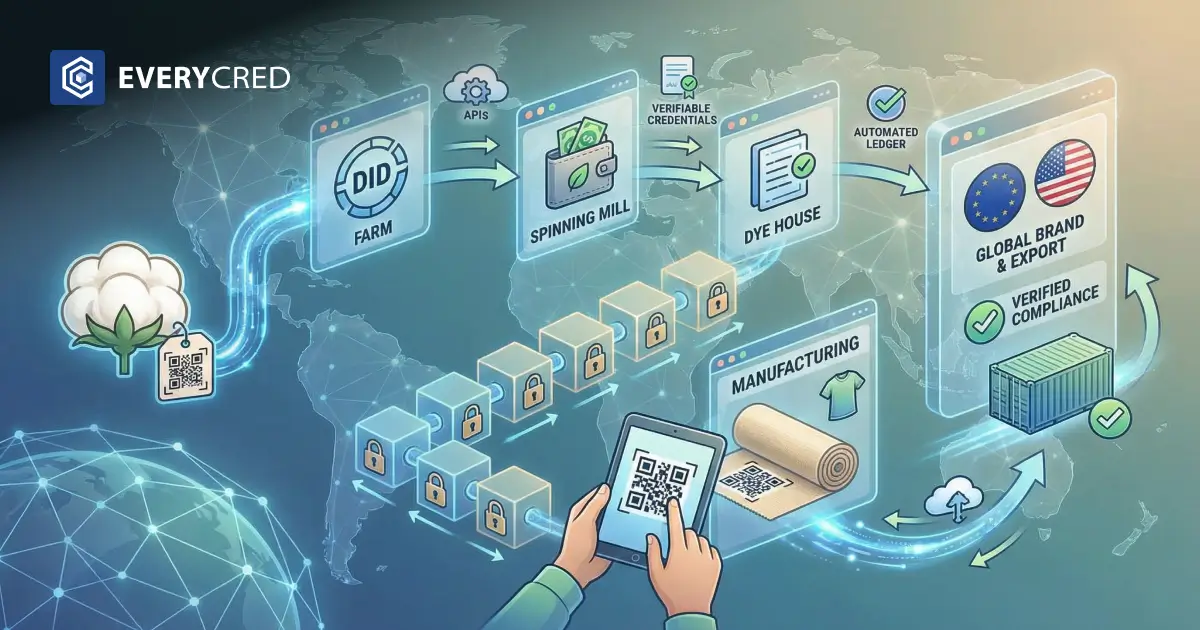
- Shifting Mandates Force Mills to Upgrade Data Systems
- Why Paper-Based Audits Create Costly Bottlenecks for Exporters
- Core Technology Needed for Digital Supply Chain Tracking
- A Direct Implementation Plan for Textile Manufacturers
- Standardize Data Formats Across Multiple Industries
- How to Overcome Legacy Infrastructure Constraints at the Mill Level
- Generate Immediate ROI Through Faster Export Clearances
- Deploy Production-Ready Tracking with EveryCRED


Global regulatory bodies require textile manufacturers to provide exact data regarding the origin of fibers, dyes, and labor conditions. Manufacturers must adopt end-to-end textile traceability to maintain their export volumes to the United States and the European Union. Implementation complexity remains the primary barrier for Indian mills. Let us show you the exact technical and operational steps manufacturers use to digitize their supply chains and secure international contracts.
Shifting Mandates Force Mills to Upgrade Data Systems
The global textile market operates on strict compliance frameworks. Buyers reject self-declared sustainability claims. They require mathematical proof of compliance at every stage of production.
- The Indian Context: The India Brand Equity Foundation (IBEF) reports that initiatives like the Kasturi Cotton India project require digital tracking infrastructure to guarantee the origin and quality of Indian cotton.
- The Digital Shift: Manufacturers use verifiable credentials to digitize these compliance documents. This standard ensures data remains tamper-evident and universally readable by auditors.
- The Consequence of Inaction: Mills failing to provide digital proof of origin face immediate contract cancellations from global fashion brands.
Why Paper-Based Audits Create Costly Bottlenecks for Exporters
Legacy tracking systems rely on physical documents and isolated databases. These methods fail modern compliance audits for several specific reasons.
Manual Data Entry Errors
Factory workers manually enter batch numbers into spreadsheets. This process causes data mismatch between the spinning mill and the dye house. Auditors spend days reconciling these discrepancies.
Fraudulent Certifications
Unverified suppliers submit altered PDF certificates for organic cotton or recycled polyester. Brands cannot instantly verify the authenticity of a standard PDF document.
Audit Delays and Holding Costs
Auditors spend weeks verifying physical invoices and shipping manifests. Transitioning to blockchain digital credentials eliminates this delay by providing immediate cryptographic proof of origin for every batch of material.
Core Technology Needed for Digital Supply Chain Tracking
To solve implementation complexity, manufacturers must standardize how facilities exchange data. The United Nations Economic Commission for Europe (UNECE) outlines frameworks for standardizing data exchanges across all value chain nodes without creating an unbearable administrative burden. A functional system requires three specific components.
Decentralized Identifiers (DIDs)
Each factory, supplier, and auditor receives a unique digital identifier. This alphanumeric string acts as a permanent digital address for the business entity.
Digital Wallets for Suppliers
Suppliers hold their eco-certifications (such as GOTS or Oeko-Tex) in secure digital wallets. They present these digital certificates to buyers upon request.
Immutable Ledger Records
When a facility processes a batch of cotton, the system generates blockchain credentials. These digital records attach to the physical batch via QR codes or RFID tags. Using a centralized system increases maintenance costs. Manufacturers lower these costs by understanding the benefits of a digital credentials platform that handles the cryptographic key management automatically.
A Direct Implementation Plan for Textile Manufacturers
Manufacturers avoid operational downtime by deploying the tracking system in distinct, manageable phases.
Phase 1: Map the Tier 1 Supply Chain
- Identify direct suppliers of yarn and raw fabric.
- Audit existing software systems used by these primary suppliers.
- Require these suppliers to submit their compliance certificates as verifiable credentials rather than paper documents.
Phase 2: Integrate APIs with Current ERP Software
- Manufacturers connect the credentialing platform to their existing SAP, Oracle, or custom ERP systems via REST APIs.
- This integration eliminates the need to replace legacy software. It solves the core issue of implementation complexity.
- This step establishes automated end-to-end textile traceability from raw material intake to final garment shipment.
Phase 3: Verify Supplier Identities Cryptographically
- Manufacturers must confirm the legal status of subcontractors.
- They implement automated checks. Implementing methods for building trust with blockchain in identity verification allows the primary manufacturer to instantly validate a subcontractor’s compliance status before issuing a purchase order.
Standardize Data Formats Across Multiple Industries
The textile industry shares supply chain tracking challenges with other heavy manufacturing sectors. Standardizing the data format ensures that customs agencies and international buyers can read the data without installing proprietary software.
Cross-Industry Application
The automotive sector tracks thousands of individual components for safety compliance. The exact architecture used for blockchain credentials in automotive compliance and safety applies directly to tracking bobbins of yarn or vats of chemical dye.
W3C Global Standards
Textile manufacturers use the World Wide Web Consortium (W3C) standards for data structuring. This ensures the digital product passports generated in India remain readable by software systems in Europe and North America.
How to Overcome Legacy Infrastructure Constraints at the Mill Level
Many Indian textile mills operate on fragmented local servers. Installing a custom blockchain network across hundreds of Tier 2 and Tier 3 suppliers is technically unfeasible. Manufacturers bypass this barrier by using cloud-based, API-driven credential issuance.
The Factory Floor Process
- A dye house receives a batch of raw fabric.
- The floor operator scans the QR code attached to the pallet.
- The local ERP system automatically pings the credentialing API.
- The system issues new blockchain credentials that record the date, time, chemical usage, and facility DID.
- This creates an unbroken chain of textile traceability without requiring factory workers to learn new software interfaces.
Generate Immediate ROI Through Faster Export Clearances
Implementing this digital infrastructure yields direct financial results for manufacturers. The initial investment in software integration pays off through operational efficiency.
Frictionless Customs Clearance
Customs officials scan the shipment’s final digital product passport at the port. They instantly verify all attached verifiable credentials. The shipment clears customs without holding delays or manual document inspections.
Accelerated Purchase Orders
Brands issue purchase orders faster because the compliance data is pre-verified. Manufacturers bypass the standard multi-week audit process during supplier onboarding.
Deploy Production-Ready Tracking with EveryCRED
Textile manufacturers require enterprise-grade infrastructure to issue and manage digital compliance documents. Building this technology from scratch requires millions of dollars in research and development. EveryCRED provides an API-first platform designed specifically for supply chain digitization.
Core Platform Capabilities
- EveryCRED integrates directly with existing ERP and inventory management systems using standard webhooks and REST APIs.
- The platform issues W3C-compliant verifiable credentials for every batch of fabric, yarn, or finished garment.
- Manufacturers generate blockchain credentials without managing nodes, cryptographic keys, or complex network protocols.
- This direct integration removes implementation complexity entirely.
By utilizing EveryCRED’s infrastructure, Indian textile mills achieve complete end-to-end textile traceability within weeks, securing their position in the global supply chain.
Contact us now to discuss how we can transform your operations and increase traceability.