27th February, 2026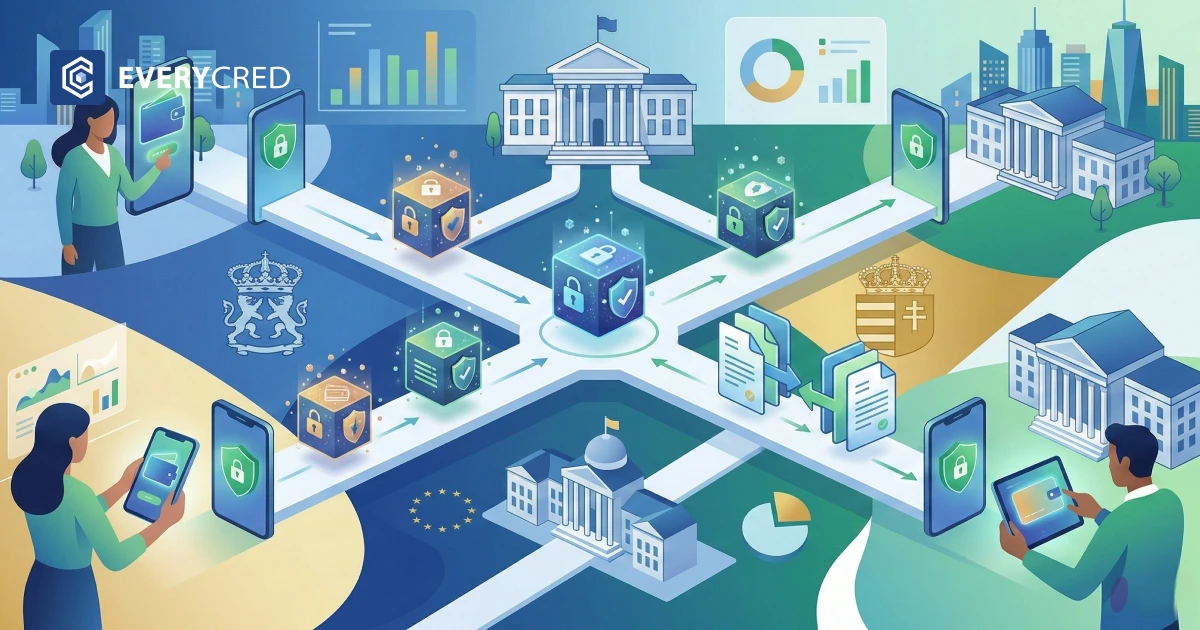
- How Do Fake Documents in the EU Disrupt Public Operations?
- What Are the Components of a Secure Credential System?
- Why Must Digital Credentials Be Interoperable?
- How Do Government Services Implement Verifiable Credentials?
- Can Interoperable Digital Credentials Stop Identity Fraud?
- How Does EveryCRED Streamline This Transition?
- Conclusion


European IT decision-makers face a severe security challenge regarding data authenticity. The circulation of fake documents in the EU forces agencies to reconsider how they issue and verify citizen data. Citizens and businesses require reliable access to government services across different Member States.
The primary mechanism to secure these processes is the deployment of interoperable digital credentials. This technology replaces paper-based workflows with cryptographically secure data files. A modern credential system stops identity fraud and ensures cross-border compatibility.
How Do Fake Documents in the EU Disrupt Public Operations?
Document fraud directly impacts the operational efficiency of European public infrastructure. Organized crime networks produce counterfeit passports, visas, and educational certificates. Identifying fake documents in the EU drains administrative resources and slows down legitimate processing times.
The Impact on Public Sector Operations
- Resource Allocation: IT departments spend significant budget maintaining disparate verification databases.
- Processing Delays: Manual review of physical documents increases the wait time for citizens accessing government services.
- Security Vulnerabilities: Counterfeit identity documents enable unauthorized access to public funds and sensitive locations.
- Cross-Border Friction: Different national standards prevent immediate verification of a citizen’s status when they move between Member States.
The elimination of fake documents in the EU relies on transitioning away from physical paper and static PDFs. European agencies must adopt digital formats that machines can cryptographically authenticate in real-time.
What Are the Components of a Secure Credential System?
A secure credential system relies on standardized architecture to guarantee data integrity. The core of a modern system is verifiable credentials. These are tamper-evident data files containing claims made by an issuer about a subject.
The Three-Party Verification Model
IT decision-makers must understand the three distinct roles within a cryptographic credential system:
- Issuers: Government agencies generate and cryptographically sign digital credentials. They write the public key to a decentralized registry.
- Holders: Citizens receive the verifiable credentials and store them in secure digital wallets on their personal devices.
- Verifiers: Other agencies or employers request cryptographic proof from the holder. They check the digital signature against the public registry to confirm authenticity.
To prevent vendor lock-in, IT leaders follow the World Wide Web Consortium (W3C) data model for verifiable credentials. This specification details the exact JSON-LD formatting required to ensure the digital files remain machine-readable across different platforms.
Why Must Digital Credentials Be Interoperable?
National governments operate unique IT infrastructures. However, digital credentials must function outside their original issuing environment. An isolated credential system creates data silos and hinders citizen mobility. The adoption of interoperable digital credentials ensures that a license issued in Germany is instantly verifiable in France.
Drivers for Cross-Border Interoperability
- Regulatory Compliance: European Commission regulations mandate the development of the European Digital Identity Wallet. Understanding eIDAS 2.0 and the future of digital identity in the public sector within Europe helps IT leaders align their infrastructure with upcoming legal requirements.
- Workforce Mobility: Public sector organizations frequently hire experts from other Member States. Standardized formats streamline credential verification for cross-border public sector hiring in Europe.
- Data Portability: Interoperable digital credentials allow citizens to control their data and share specific claims without exposing their entire identity document.
- System Integration: Standardized APIs and DID (Decentralized Identifier) methods allow different software systems to read the same digital credentials without custom coding.
How Do Government Services Implement Verifiable Credentials?
Transitioning from legacy databases to decentralized architecture requires deliberate planning. IT decision-makers must evaluate how verifiable credentials integrate with their existing identity access management (IAM) tools. Upgrading a legacy database to a cryptographic credential system reduces friction for end-users.
Implementation Phases for IT Departments
- Evaluate Issuance Capabilities: Determine which legacy systems currently generate citizen data. Connect these databases to an issuance engine capable of formatting W3C-compliant files.
- Select Decentralized Identifiers (DIDs): Choose the specific DID methods (such as did:web or did:evrc) that the agency will use to publish public keys.
- Develop Verification Portals: Update online portals for government services to accept verifiable presentations from citizen wallets.
- Audit for Compliance: Ensure the implementation meets regional privacy laws and technical standards. IT buyers must conduct thorough eIDAS compliant credential verification reviews during vendor selection.
The table below outlines the functional differences between legacy methods and a modern approach.
| Feature | Legacy Document Verification | Verifiable Credentials Architecture |
| Data Format | Paper, static PDF, JPEG | JSON-LD, JWT (JSON Web Tokens) |
| Verification Method | Manual visual inspection, phone calls | Automated cryptographic signature check |
| Fraud Resistance | Low (easily forged or edited) | High (tamper-evident mathematical proofs) |
| Interoperability | Low (requires custom bilateral agreements) | High (based on open W3C standards) |
| Revocation | Slow (relies on manual database updates) | Instant (status lists or cryptographic accumulators) |
| Privacy | Poor (over-sharing of personal data) | High (supports selective disclosure and zero-knowledge proofs) |
Can Interoperable Digital Credentials Stop Identity Fraud?
Yes. The mathematical properties of interoperable digital credentials make undetectable forgery mathematically impossible. When an agency issues a digital file, it signs the data packet with a private cryptographic key.
Fraud Prevention Mechanisms
- Tamper Detection: If a malicious actor alters a single character within the digital credentials, the cryptographic hash changes. The verification software immediately flags the document as invalid.
- Source Authentication: The verifier software automatically checks the decentralized registry to confirm the issuer’s public key. This proves the document originated from an authorized government entity.
- Revocation Checks: Government services can revoke a credential instantly. The verification software queries a cryptographic revocation list to ensure the document remains active at the exact moment of presentation.
By demanding cryptographic proof rather than visual inspection, agencies completely neutralize the threat of fake documents in the EU. A system built on trust credentials guarantees data provenance and protects public resources from exploitation.
How Does EveryCRED Streamline This Transition?
Implementing interoperable digital credentials requires scalable and compliant infrastructure. EveryCRED provides the foundational API integrations and blockchain-powered architecture necessary for European governments to issue and verify secure data. The platform utilizes Merkle proof security and supports the W3C-compliant EVRC DID method.
EveryCRED enables IT departments to automate the issuance process, integrate verification portals directly into existing workflows, and ensure full compliance with emerging European digital identity frameworks. The system processes cryptographic checks instantly, eliminating manual review bottlenecks and securing public sector operations against sophisticated document fraud.
Conclusion
IT decision-makers must prioritize the transition to interoperable digital credentials to meet regulatory requirements and secure public infrastructure. The ongoing circulation of fake documents in the EU renders legacy verification methods obsolete and dangerous. By implementing a standardized credential system based on verifiable credentials, agencies protect data integrity and automate authentication processes. Digital credentials ensure that access to government services remains secure, efficient, and fully compatible across European borders.