27th January, 2026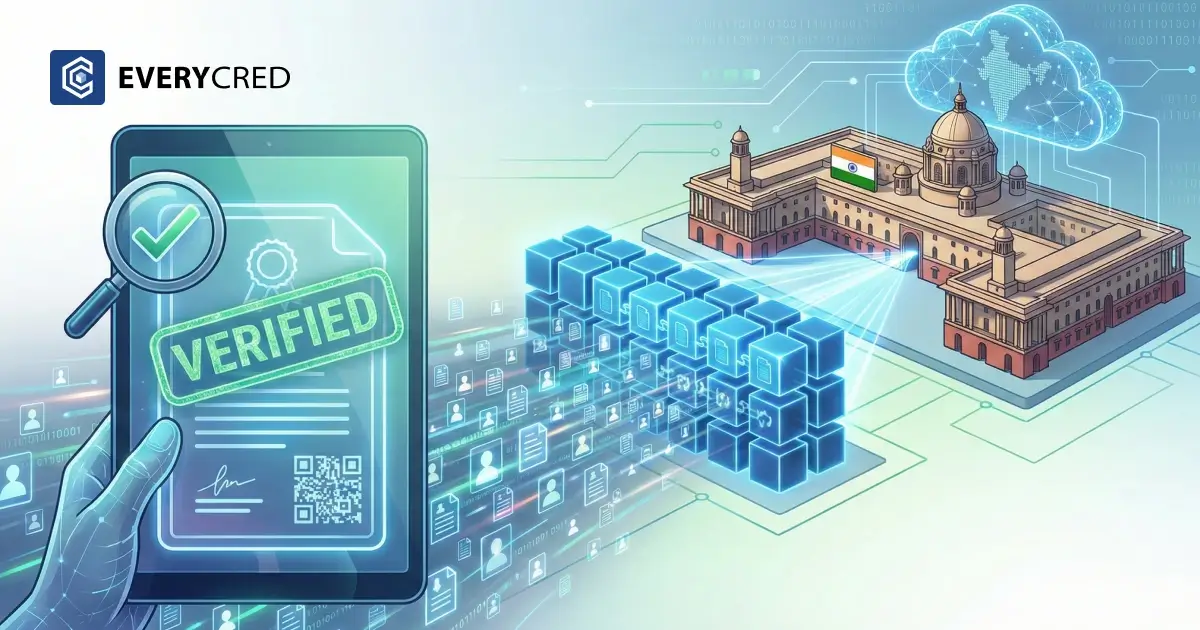
- The Scale of Recruitment in India
- What Are Verifiable Credentials
- Strategic Benefits of Automated Credential Verification
- Manual vs. Digital Verification
- Integrate EveryCRED into Government Portals
- Security and Legal Compliance
- Efficiency in Large Scale Recruitment
- Future-Proof Recruitment with EveryCRED
- Conclusion


In the current recruitment landscape in India, government agencies manage millions of applications for various civil service and technical roles. Managing the document verification process for such volumes requires high operational efficiency and security. Large scale credential verification has moved from manual, paper-based checks to digital systems that utilize verifiable credentials to ensure the authenticity of candidate data.
EveryCRED provides a digital infrastructure designed to support these high-volume recruitment cycles by automating credential verification. This transition reduces the time required for background checks from months to seconds.
The Scale of Recruitment in India
Government recruitment drives in India often involve hundreds of thousands of candidates applying for a limited number of vacancies. For example, the Railway Recruitment Boards and the Staff Selection Commission process applications that require verifying academic degrees, caste certificates, and identity proofs. Traditional methods involve physical document submission and manual cross-referencing with universities or issuing authorities. This process is slow and susceptible to document forgery.
Implementing large scale credential verification allows these agencies to handle data in bulk. By using digital systems, recruiters can verify the qualifications of an entire cohort of candidates simultaneously. This capability is essential for meeting the hiring timelines set by the National Education Policy 2020, which emphasizes the use of digital academic records to streamline professional mobility.
What Are Verifiable Credentials
Verifiable credentials are digital versions of physical documents that include cryptographic signatures. These signatures allow any authorized party to confirm the issuer’s identity and the integrity of the data without contacting the original issuer every time. In India, the use of these credentials aligns with the “India Stack” philosophy, which promotes digital-first public infrastructure.
EveryCRED uses these standards to provide verifiable digital credentials that are tamper-proof. When a government department receives a digital certificate through the EveryCRED platform, the system checks the cryptographic proof against the blockchain ledger. If a single character in the document has been altered, the verification fails instantly. This level of security is necessary for maintaining the integrity of public sector hiring.
Strategic Benefits of Automated Credential Verification
For government departments, the primary goal of credential verification is to mitigate risk. Hiring a candidate based on fraudulent documents can lead to legal complications and reputational damage. Large scale credential verification platforms like EveryCRED automate the validation of:
- University degrees and transcripts.
- Professional certifications and licenses.
- Employment history and experience letters.
- Identity documents linked to national databases.
By integrating these checks into the initial stages of the recruitment funnel, agencies ensure that only qualified candidates proceed to the interview or examination stages. This prevents the administrative burden of conducting detailed background checks on thousands of applicants at the final stage. You can learn more about how these systems function in our guide on what digital credentials are.
Manual vs. Digital Verification
The following table outlines the operational differences between traditional verification methods and the automated credential verification systems provided by EveryCRED.
| Feature | Manual Process | EveryCRED Digital System |
| Verification Speed | 2 to 12 weeks | Instant (seconds) |
| Data Integrity | High risk of human error or forgery | Tamper-proof cryptographic signatures |
| Cost Efficiency | High per-candidate cost (couriers, staff) | Low, volume-based cost structure |
| Scalability | Limited by physical manpower | Virtually unlimited for large scale drives |
| Candidate Experience | Requires physical travel/mailing | Fully digital and remote |
Integrate EveryCRED into Government Portals
Government recruitment portals in India can integrate EveryCRED’s capabilities through REST APIs. This allows for a seamless flow of data between the application portal and the verification engine. When a candidate uploads their digital wallet link or a QR-coded certificate, the portal triggers an API call to EveryCRED. The system then performs large scale credential verification across the specified dataset.
This integration supports the National Academic Depository (NAD) initiatives, where academic records are stored in a central, digital format. EveryCRED acts as the bridge between these repositories and the recruiting agency, providing a secure credential verifier interface for HR managers.
Security and Legal Compliance
In India, the Information Technology Act, 2000, provides legal recognition to electronic records and digital signatures. Verifiable credentials issued and verified through EveryCRED comply with these legal standards. The system utilizes Decentralized Identifiers (DIDs) to ensure that the candidate retains control over their data while allowing the government to verify it with consent.
Using blockchain technology for large scale credential verification ensures that there is no central point of failure. Every verification transaction is logged, providing an audit trail that is useful for transparency and compliance reporting. This is particularly important for public sector roles where hiring transparency is a legal requirement. Our blog on trust in public services explains how these technologies rebuild citizen confidence in government processes.
Efficiency in Large Scale Recruitment
The move toward large scale credential verification is not merely a technological upgrade but an operational necessity. As the volume of applicants increases, the cost of manual checks becomes unsustainable. EveryCRED offers volume-based contracts that allow government departments to scale their verification needs according to the recruitment calendar. This model ensures that agencies only pay for the number of verifications performed, providing a clear return on investment.
Verifiable credentials also eliminate the need for “attestation” by gazetted officers, a process that has historically caused delays for candidates in India. Instead, the digital signature of the issuing institution serves as a permanent, self-attesting proof of authenticity. This speeds up the onboarding process, allowing government departments to fill vacancies faster.
Future-Proof Recruitment with EveryCRED
The recruitment landscape is evolving toward a “Zero Trust” model where every claim made by a candidate must be backed by verifiable credentials. For government agencies in India, adopting this model means they can handle any volume of applications without increasing their HR staff. Credential verification through EveryCRED provides the following long-term advantages:
- Reduced Fraud: Eliminates the market for fake degrees and experience certificates.
- Faster Onboarding: Candidates can start their roles weeks earlier than under manual systems.
- Standardized Data: Ensures that all applicant data is in a machine-readable format for better analytics.
Implementing large scale credential verification is the most effective way to manage the complexities of modern public sector hiring. By utilizing the EveryCRED platform, agencies can focus on selecting the best talent rather than verifying paperwork.
Conclusion
The transition to verifiable credentials is a fundamental shift in how trust is established during recruitment in India. Manual credential verification is no longer viable for agencies processing thousands of applications. EveryCRED provides the tools necessary to conduct large scale credential verification with speed, accuracy, and legal compliance. This technology ensures that the most qualified individuals serve in the public sector, protected by a tamper-proof digital ecosystem.