4th June, 2026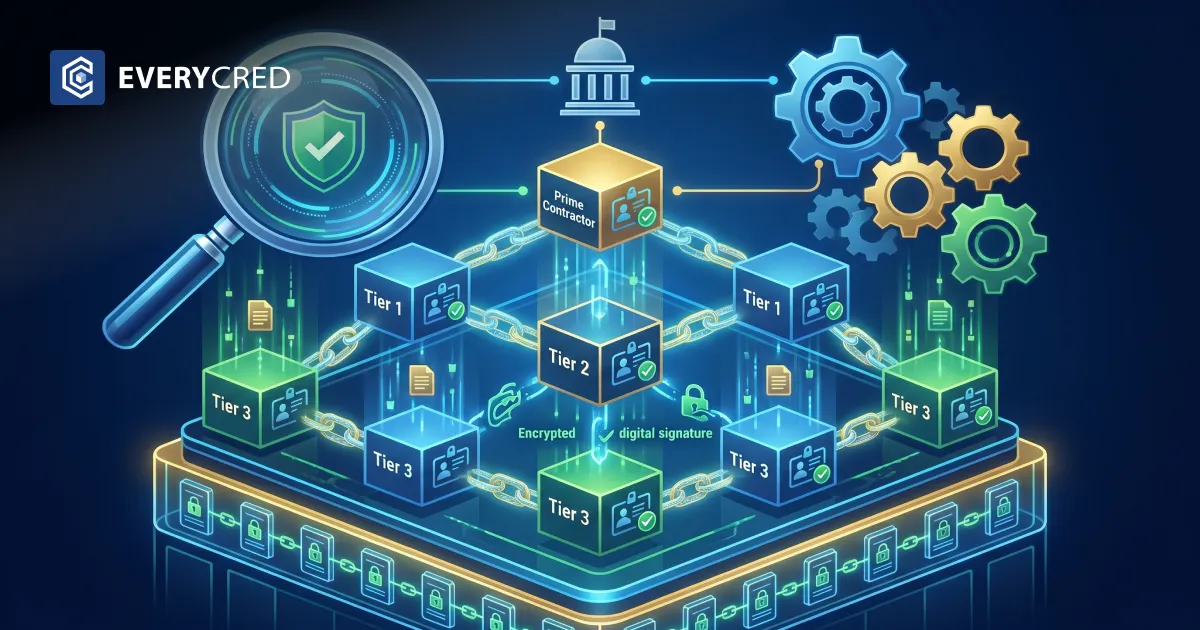
- Why Prime-Only Checks Leave Federal Contracting Risk Unmanaged
- What Flow-Down Already Requires, and What It Still Misses
- A Four-Step Tier-2 and Tier-3 Credentials Verification Model
- A Flow-Down Clause Template for Subcontractor Credentials Verification
- How EveryCRED Deploys Verifiable Supply Chain Identity
- Conclusion
- FAQs


Federal contracting officers can verify the prime contractor, but they lose identity visibility at the tier-2 and tier-3 firms that perform much of the work. A verifiable-credential model closes that gap. It makes credentials verification an enforceable, auditable requirement at every flow-down boundary, not a contractual promise on paper.
Supply-chain rules already require compliance to flow down to subcontractors at all tiers. FASCSA, CMMC, and Section 889 each mandate it. What they do not give a contracting officer is real-time proof of who each tier-2 vendor is, that named key personnel are who they claim to be, and that those attestations were valid at the moment work was performed. That unverified identity layer is where federal contracting risk concentrates. This article gives you a four-step model and a flow-down clause template you can put to work before the next FAR update lands.
Key Takeaways
– FASCSA clauses FAR 52.204-28, -29, and -30 require supply-chain prohibitions to flow down to subcontractors at every tier.
– CMMC Phase 2 begins November 10, 2026, requiring C3PAO-assessed Level 2 certification that primes must flow down for FCI and CUI.
– Manual credential verification costs $15 to $25 per check; verifiable credentials cost under $0.10 per check.
– A tier-2 and tier-3 credentials verification model binds each subcontractor to a NIST SP 800-63-4 identity assurance level and logs every check to an immutable audit trail.
Why Prime-Only Checks Leave Federal Contracting Risk Unmanaged
Most verification stops at the prime. The contracting officer confirms the prime’s SAM registration, CAGE code, and representations, then trusts the prime to manage everyone below. The work, however, runs deeper. Tier-2 and tier-3 subcontractors handle data, build components, and staff the effort.
That creates a visibility cliff. A prime can name its first-tier subcontractors, but identity assurance thins out fast below that line. The agency rarely sees who the tier-2 vendor actually is, and rarely sees tier-3. This is where most federal contracting risk hides.
One missed identity check carries real consequences. Under FAR 52.203-13, a contractor must disclose to the Office of Inspector General when it has credible evidence that a subcontractor committed fraud. An undetected impostor or a misrepresented entity can trigger a stop-work order, an OIG referral, or False Claims Act exposure. Stronger subcontractor verification removes that blind spot before award.
What Flow-Down Already Requires, and What It Still Misses
Federal supply-chain rules already push obligations down the chain. They are explicit that subcontractors at all tiers are in scope.
- FASCSA: Clauses FAR 52.204-28, 52.204-29, and 52.204-30 prohibit covered articles and sources subject to exclusion or removal orders, and contractors must flow these prohibitions down to subcontracts at every tier.
- CMMC: DFARS 252.204-7012 flows down verbatim, and DFARS 252.204-7021 plus 32 CFR 170.23 extend certification duties to any subcontractor that processes federal contract information or controlled unclassified information.
- Section 889: The NDAA for FY2019 bars named telecommunications equipment and services, checked against SAM exclusions.
These rules govern what a subcontractor may use and how it protects data. They do not establish, in real time, who that subcontractor is. A flow-down clause can say a tier-2 vendor must comply, yet the agency still cannot cryptographically confirm the entity or its key personnel. That identity gap is the part of supply chain identity that current clauses leave open, and it is the part this model fixes.
A Four-Step Tier-2 and Tier-3 Credentials Verification Model
This model treats subcontractor identity as a verifiable artifact at each flow-down boundary. It uses verifiable credentials issued to entities and their named personnel, then checked at every tier.
- Issue a credential at onboarding. When a subcontractor joins the chain, the responsible party issues a cryptographically signed credential covering the entity and its key personnel. The credential carries a digital signature that breaks if anyone alters it.
- Bind it to an identity assurance level. Each credential maps to a NIST SP 800-63-4 Identity Assurance Level, IAL2 or IAL3, depending on sensitivity, so the assurance is explicit and audit-ready.
- Require presentation at each boundary. Prime to tier-1, tier-1 to tier-2, and tier-2 to tier-3, the receiving party scans and validates the credential before work begins. A tier-2 vendor cannot pass work down without a valid credential from the next tier.
- Log every check to an immutable record. Each verification writes to an audit-ready record with a timestamp and the verifying actor, from pre-award through closeout.
The result is continuous credentials verification across the full chain. Every tier proves its identity, and the agency can prove who was verified, when, and at what assurance level. This turns subcontractor verification into a standing control rather than a one-time form.
A Flow-Down Clause Template for Subcontractor Credentials Verification
A model only holds if the obligation travels down the chain in contract language. The clause below gives primes plain text to insert into subcontracts at all tiers. It mirrors how FASCSA and CMMC duties already flow down, so it fits existing acquisition practice and the next FAR update.
Verifiable Identity Flow-Down (template). The Subcontractor shall present a verifiable credential, issued under the W3C Verifiable Credentials Data Model 2.0 and bound to a NIST SP 800-63-4 Identity Assurance Level no lower than IAL2, attesting to the identity of the Subcontractor entity and its key personnel. The Subcontractor shall require each lower-tier subcontractor to present an equivalent credential before performance. Each presentation shall be verified and logged to an immutable audit trail. This clause shall flow down to subcontracts at all tiers.
Two points make this practical. First, the credential is checkable without contacting the issuer, so verification scales across hundreds of tier-2 vendor relationships. Second, because each check is logged, the prime can produce evidence of subcontractor verification on demand. That converts a paper attestation into a provable supply chain identity. Agencies evaluating this approach often pair it with a vendor requirements checklist so expectations are explicit before award.
How EveryCRED Deploys Verifiable Supply Chain Identity
We built our Trust Supply Chain product to verify vendor and contractor identity across procurement, with an immutable audit trail at every step. Each credential is signed using the W3C Verifiable Credentials Data Model 2.0 and checks in under 10 seconds, online or offline, through QR or NFC. The platform integrates via REST API with no front-end changes to existing procurement systems. US agencies can procure through Carahsoft on NASA SEWP V and ITES-SW2, with no new competitive cycle. Download our tier-2 and tier-3 verification framework and flow-down clause template, then request a demo to walk through a pre-award deployment.
Conclusion
Prime-only checks leave the riskiest part of the federal supply chain unverified. Tier-2 and tier-3 firms perform the work, yet their identity is the layer current flow-down rules do not confirm. FASCSA, CMMC, and Section 889 already require compliance to travel down the chain, so extending that flow-down to verifiable identity is a natural next step.
The four-step model and clause template here make credentials verification enforceable at every boundary and provable in any audit. With CMMC Phase 2 arriving on November 10, 2026, agencies that adopt verifiable subcontractor verification now will be ready when identity assurance becomes the expectation, not the exception.
FAQs
What are the tier-2 and tier-3 subcontractor credentials verification?
It is the practice of cryptographically confirming the identity of lower-tier subcontractors and their key personnel at each flow-down boundary.
Do federal flow-down clauses already cover subcontractor identity?
No. FASCSA, CMMC, and Section 889 flow compliance down to all tiers, but do not verify the real-time identity of each subcontractor entity.
How does verifiable credentials verification reduce federal contracting risk?
It proves who each tier-2 vendor is before work begins and logs every check, removing the identity blind spot that triggers stop-work orders.
What does the flow-down clause template require subcontractors to do?
It requires each subcontractor to present a NIST SP 800-63-4 credential and requires the same from every lower tier before performance.
Can agencies deploy supply chain identity verification through existing contracts?
Yes. EveryCRED is available through Carahsoft on NASA SEWP V and ITES-SW2, with no new competitive procurement cycle required.