3rd July, 2026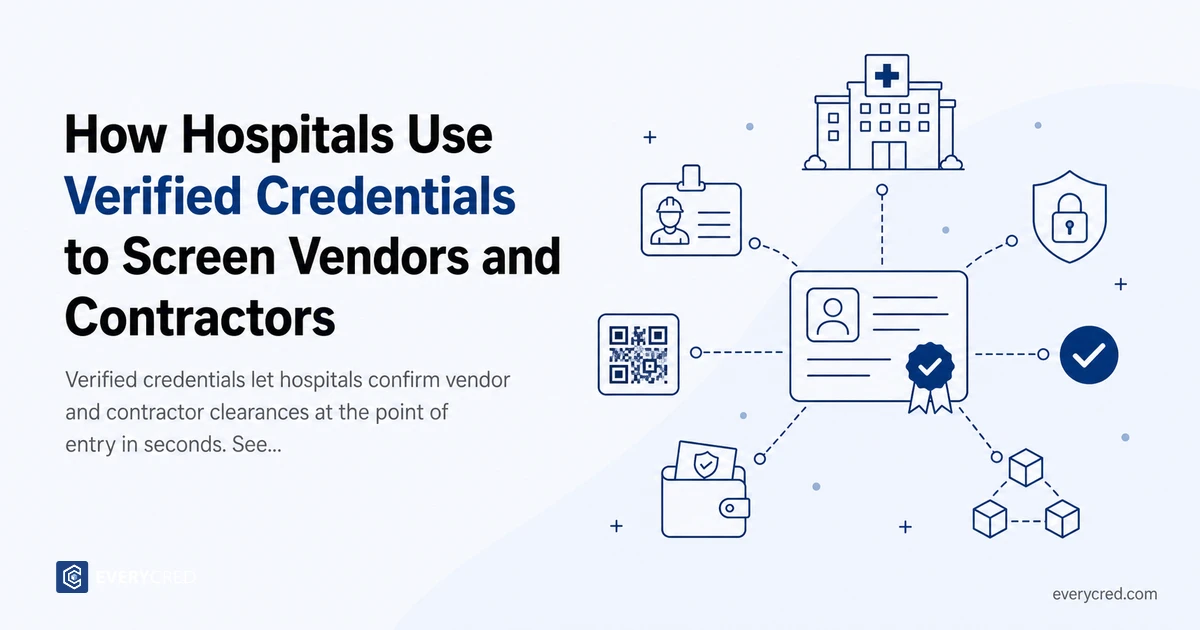
- Why Paper Badges Fail at the Hospital Door
- What Verified Credentials Change About Vendor Credentialing
- How Point-of-Entry Facility Access Verification Works
- How Verified Credentials Prove Who Held Access at the Moment of Entry
- Contractor Verification Beyond the Hospital Lobby
- Book a Facility Access Pilot With EveryCRED
- Conclusion
- Frequently Asked Questions


Hospitals verify vendor and contractor credentials at the point of entry by issuing verified credentials. These are cryptographically signed digital proofs that a security officer confirms in seconds before granting facility access. The credential proves identity, clearance, and required certifications at the moment someone reaches the door. Paper and plastic badges cannot do that. A badge printed last month says nothing about a background check that lapsed last week or an immunization that expired yesterday. This guide explains how verified credentials close the point-of-entry gap for vendor credentialing and contractor verification. It shows how the check runs in seconds. It also shows how hospitals prove who held valid facility access at the moment of entry.
Key Takeaways
- Verified credentials confirm a vendor’s identity, clearance, and certifications at the door in under 10 seconds, not at enrollment weeks earlier.
- Real-time revocation invalidates a contractor’s access the instant a clearance lapses, so an expired credential fails at the next scan.
- Every verification writes an immutable, timestamped record, proving who held valid facility access at the exact moment of entry.
- Offline verification works at loading docks and remote entrances with no network connection, using cached cryptographic signatures.
Why Paper Badges Fail at the Hospital Door
A paper or plastic badge is a static snapshot. It confirms a status at the moment it was printed, not at the moment a vendor reaches the door. Vendor clearances expire on rolling schedules. Background checks, immunizations, safety training, and liability insurance each lapse on their own timeline.
Most hospital vendor credentialing systems check documents once at enrollment, then issue a badge. That badge cannot be rechecked at entry. A security officer has no way to confirm the underlying certifications are still valid today.
Forged badges are cheap. A printed badge or PDF certificate costs under $30 to fake. AI-forged documents grew 311% between the first quarters of 2024 and 2025. Identity assurance frameworks such as NIST SP 800-63-4 stress verifying identity at the point of use, not only at onboarding. The point-of-entry gap is exactly where lapsed clearances and forged documents slip through.
What Verified Credentials Change About Vendor Credentialing
Verified credentials move the proof into the credential itself. When a hospital or a credentialing body issues one, it signs the credential with a private cryptographic key. Any later change to the credential breaks that signature, so tampering is detectable on the spot.
This changes vendor credentialing in three practical ways. First, verification happens against the cryptographic signature, not a document filed months ago. Second, a credential can be revoked in seconds, so a vendor removed for cause cannot present a valid badge the next day. Third, the credential carries only the claims a verifier needs, such as active clearance status, without exposing a full personnel file.
For hospitals already managing physician and staff healthcare credentials, extending the same standard to vendors and contractors removes a second, weaker system. One trust model covers employees, device reps, and contractors alike.
How Point-of-Entry Facility Access Verification Works
The workflow mirrors the issuer, holder, and verifier model behind every verifiable credential. The hospital or an accredited credentialing body issues the credential to the vendor. The vendor stores it in a digital wallet on their phone.
At the entrance, a security officer scans a QR code. The system checks the cryptographic signature, confirms the credential has not been revoked, and validates that each required certification is still current. It returns a clear pass or fail result in seconds, with no phone call and no database lookup.
Speed at the door is not theoretical. Raigad Police cut field credential verification from 30 minutes to under 10 seconds using the same QR-based method. Field officers verified credentials offline, with no network connection. A hospital loading dock or a remote clinic entrance can run the same check without connectivity. This is where instant verification replaces the clipboard and the printed facility access list.
How Verified Credentials Prove Who Held Access at the Moment of Entry
Access logs from a badge reader show that a badge was swiped. They do not prove the badge represented a valid, current clearance at that second. Verified credentials close that gap by recording each verification as an immutable, timestamped event.
Every scan creates a permanent record, documenting which credential was presented, whether it passed, and exactly when. If a dispute or investigation arises, the hospital can show who held valid access at the precise moment of entry. Cryptographic proof backs the record, not a printout.
This matters for accreditation reviews, incident investigations, and liability questions. A security director can produce audit-ready credentials that withstand scrutiny, as the record cannot be edited after the fact. Verified credentials turn the access log from a list of swipes into defensible evidence.
Contractor Verification Beyond the Hospital Lobby
Contractor verification rarely stops at the main lobby. Construction crews, IT contractors, environmental services, and traveling clinicians enter through many doors and across multiple sites. Each needs the right clearance, and each clearance changes over time.
Verified credentials handle this at scale. A subcontractor’s electrician can present a live proof of an active license, and the verifier confirms it without calling the licensing board. This is the same principle behind automated professional license verification, applied at the physical door.
Real-time revocation is the safeguard. When a contractor is offboarded, the hospital revokes the credential, and the next scan fails immediately. The cost case is direct too. Manual credential checks run $15 to $25 each, while automated verification costs under $0.10 per check. For vendor and contractor programs that verify thousands of entries a year, the savings compound. Hospitals extending credentials across suppliers can apply the same model to broader vendor verification throughout procurement.
Book a Facility Access Pilot With EveryCRED
We deployed offline QR-based credential verification for Raigad Police. It cut field verification from 30 minutes to under 10 seconds and reduced administrative overhead by 85%. The same approach secures hospital facility access. Our platform issues tamper-proof verified credentials, revokes them in seconds, and verifies them at any entrance, online or offline. It runs through a REST API that adds no front-end changes to your access control system. Public health systems and government hospitals can procure through Carahsoft on NASA SEWP V and ITES-SW2. Book a demo to scope a facility access pilot for your vendor and contractor entry points.
Conclusion
Hospital security depends on knowing who is inside and whether they belong there. Paper badges answer that question at enrollment, then go stale. Verified credentials answer it at the door, every time, in seconds.
For vendor credentialing and contractor verification, the shift is practical. Clearances are checked live, and revocation takes effect immediately. Every entry produces a permanent record of who held valid facility access when they walked in. Forged badges and lapsed certifications lose their opening.
Hospitals that move vendor and contractor access onto cryptographically verified credentials replace a fragile paper process with defensible proof. As accreditation and liability standards tighten, point-of-entry verification will become the baseline expectation, not the exception.
Frequently Asked Questions
How do hospitals verify vendor credentials at the point of entry?
A security officer scans the vendor’s verified credentials, and the system confirms identity, clearance, and certifications in seconds.
What happens if a contractor’s clearance expires or is revoked?
Real-time revocation invalidates the credential immediately, so the next scan at any entrance fails until the clearance is restored.
Can verified credentials be checked without an internet connection?
Yes, offline verification uses cached cryptographic signatures, so entrances like loading docks confirm credentials with no network connection.
How do verified credentials prove who had valid facility access?
Each scan writes an immutable, timestamped record showing which credential passed and exactly when someone entered the facility.
Are digitally verified credentials harder to forge than paper badges?
Yes, each credential carries a cryptographic signature, and any alteration breaks it, making forgery detectable instantly at verification.