20th April, 2026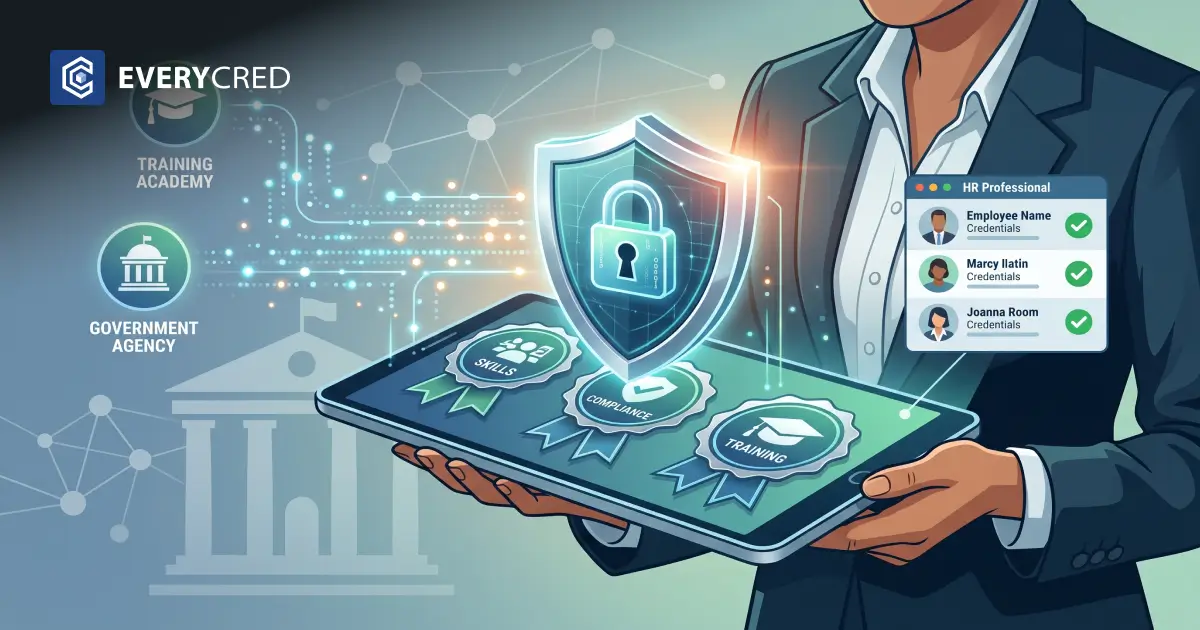
- Paper Records Fail the Compliance Test
- The Architecture of Digital Badges in Public Administration
- Resolving Bottlenecks in Internal Mobility
- How to Eliminate Credential Fraud in Contractor Management
- Cryptographic Security Meets Federal Standards
- The Transition to Machine-Readable Open Data
- EveryCRED Infrastructure Supports Strict Compliance Needs
- Final Words
- FAQs


Government agencies manage large and complex workforces. Tracking employee skills requires precise training validation. Traditional paper certificates slow down background checks and create compliance risks. Government HR departments require exact data to confirm employee qualifications.
Verifiable credentials solve this problem directly. These digital records give government HR teams an exact and tamper-proof method for workforce certification. This technology replaces manual document reviews with automated cryptographic verification.
Paper Records Fail the Compliance Test
Government HR professionals need secure workforce certification methods. Paper certificates present severe security and operational risks.
- High fraud risk: Employees or contractors can forge PDF certificates easily. Image editing software allows individuals to alter dates and names on digital documents.
- Slow verification processes: HR staff must call issuing institutions to confirm the validity of a certificate. This manual process takes days or weeks to complete.
- Lost data over time: Physical records degrade or disappear. Poorly managed digital files get lost on local computer drives.
- Poor audit trails: Paper systems lack automated tracking. Auditors struggle to verify compliance histories accurately.
Digital badges replace these manual systems with secure and verifiable data.
The Architecture of Digital Badges in Public Administration
Agencies use verifiable credentials to confirm that an employee completed specific training. The system relies on advanced cryptography to secure the data.
Credential Issuance
The training academy or internal department issues digital badges to the employee upon course completion. The software signs the record with a unique cryptographic key.
Secure Storage
The employee holds the credential in a secure digital wallet. The employee controls access to this wallet and presents the credential when required by HR.
Instant Verification
The government HR department checks the credential instantly using software. The system reads the cryptographic signature to confirm authenticity.
The World Wide Web Consortium outlines exact W3C standards for these systems. This framework ensures that verifiable credentials remain secure and uniform across different departments.
Resolving Bottlenecks in Internal Mobility
Government employees often transfer between departments. Each transfer requires strict training validation to ensure the employee meets the requirements of the new role.
- Immediate skill verification: HR accesses the digital record instantly. There is no waiting period for external confirmation.
- Automated skill matching: Software systems read digital badges to match employees with new roles. This speeds up the internal hiring process.
- Faster security clearances: HR verifies compliance records and security training without delay. This keeps critical government functions fully staffed.
- Reduced administrative overhead: Staff spend less time processing paperwork and more time managing human resources.
Securing these records protects sensitive personnel data. Implementing proper verifiable credentials in cybersecurity prevents unauthorized access to government HR records.
How to Eliminate Credential Fraud in Contractor Management
Government agencies rely on external contractors for specific projects. Verifying contractor qualifications presents a major challenge for HR departments.
Mandatory Proof of Skills
Agencies require contractors to prove their specific technical skills. Traditional resumes offer zero proof of actual capability.
Cryptographic Certainty
Verifiable credentials provide mathematical proof of a contractor’s skills. The cryptographic signature confirms the issuing authority.
Automated Expiration Tracking
Contractor certifications expire. Digital systems track these expiration dates automatically and alert HR when a contractor requires recertification.
Cryptographic Security Meets Federal Standards
Digital records must meet strict government regulations. Federal frameworks require specific security protocols to protect identity data.
- Precise identity proofing: Systems link the credential to the correct employee. This prevents individuals from using another person’s certification.
- Strict authentication protocols: Platforms require secure logins to access records. Multi-factor authentication adds an extra layer of security.
- Immutable data integrity: Cryptography prevents any alteration of the record. The credential becomes invalid if someone attempts to change the data.
- Data privacy compliance: The systems only share necessary data. HR views the certification status without accessing unrelated personal information.
The National Institute of Standards and Technology provides strict digital identity guidelines for these systems. Agencies maintain audit-ready digital credentials by following these established federal protocols.
The Transition to Machine-Readable Open Data
Government agencies require systems that communicate with each other. Verifiable credentials use open data formats to ensure interoperability.
Standardized Language
Different software platforms read the same credential data. The machine-readable format allows systems from different agencies to understand the certificate details.
Automated Reporting
HR systems generate compliance reports automatically. Managers view real-time data on department-wide training completion rates.
Centralized Skill Registries
Agencies build central databases of certified personnel. In emergencies, HR locates staff with specific qualifications instantly.
These features support massive public sector solutions. HR departments manage thousands of digital badges efficiently using these interoperable systems.
EveryCRED Infrastructure Supports Strict Compliance Needs
Government HR departments need secure platforms for workforce certification. EveryCRED provides the technical infrastructure to issue, manage, and verify digital badges securely. Our platform integrates directly with your existing HR software.
We automate training validation and maintain permanent compliance logs. Your agency controls the cryptographic keys and the issuance rules. You can schedule a demo of EveryCRED to see the exact verification process and test the administrative dashboard.
Final Words
Verifiable credentials provide exact training validation for government employees. Agencies eliminate manual verification steps and secure their workforce certification processes. Digital badges meet federal security standards and enable immediate internal mobility. Upgrading to cryptographic credentials protects agency data and improves HR efficiency. Government departments reduce administrative costs and maintain strict compliance by adopting this technology.
FAQs
What are verifiable credentials in government?
They are secure and tamper-proof digital records that prove an individual holds specific qualifications or clearances.
How do digital badges improve training validation?
Digital badges allow HR departments to confirm training completion instantly using automated cryptographic verification software systems.
Why does government HR need digital workforce certification?
Digital certification eliminates document fraud, automates compliance tracking, and speeds up internal employee transfers between departments.
Are verifiable credentials secure enough for federal use?
Yes. They use advanced cryptography and align strictly with federal identity and access management security guidelines.
Can digital badges transfer between government agencies?
Yes. Standardized open data formats allow different agency software systems to read and verify the exact badge.