26th June, 2026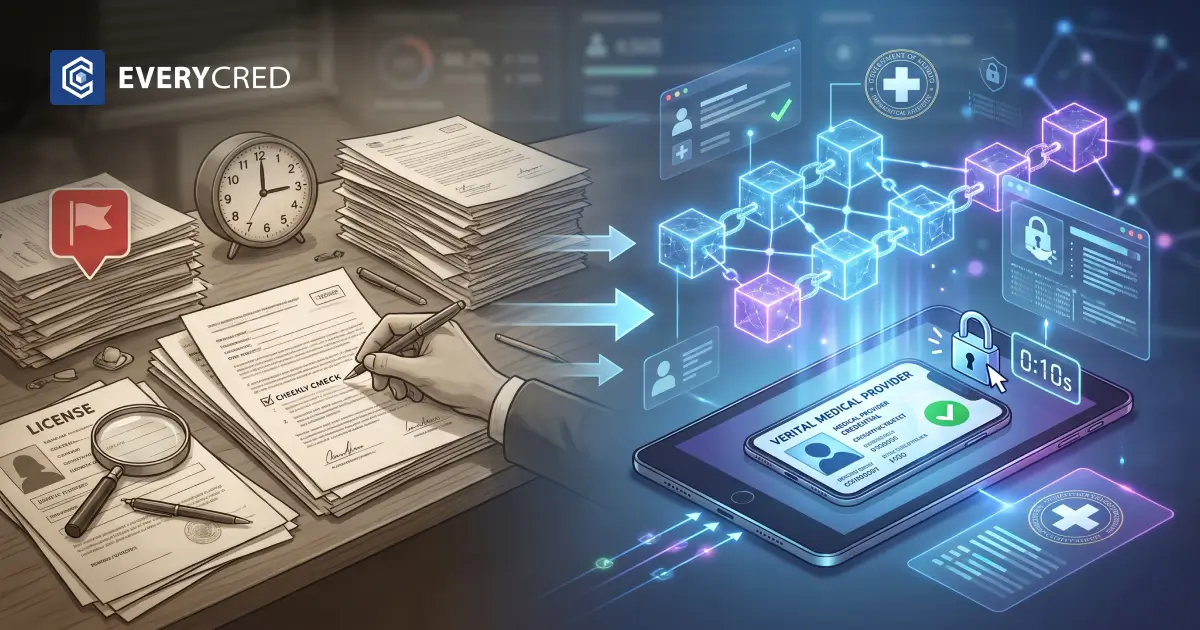
- Why Medicaid Provider Enrollment Verification Fails Today
- How Blockchain Identity Verification Confirms Provider Identity
- Mapping Blockchain Identity Verification to 42 CFR 455 Screening
- What State Medicaid Agencies Gain From Verifiable Credentials
- How We Help State Medicaid Agencies Deploy This
- Conclusion
- FAQs


Blockchain identity verification confirms a Medicaid provider’s identity and credentials at enrollment, then makes each check tamper-evident and re-verifiable in seconds. It does not replace federal provider screening rules. It strengthens them by turning slow, forgivable document reviews into cryptographic checks that a state can repeat at any time.
State Medicaid agencies enroll and re-screen providers using documents that are slow to confirm and easy to falsify. An ineligible or fraudulent provider can bill the program for months before a manual review catches it. CMS estimated $37.39 billion in Medicaid improper payments in FY2025, a 6.12% error rate. This guide shows how blockchain identity verification closes the gap between enrollment, screening, and revalidation and strengthens Medicaid integrity.
Key Takeaways
- CMS estimated $37.39 billion in Medicaid improper payments in FY2025, up from $31.1 billion in FY2024.
- In about 5% of reviewed claims, roughly $1.5 billion, the provider was not properly enrolled or screened.
- Federal rules (42 CFR Part 455) require risk-based provider screening and revalidation at least every five years.
- Blockchain identity verification makes each provider credential tamper-evident and re-checkable in under 10 seconds.
- Verifiable credentials add an immutable audit trail for CMS, GAO, and Medicaid program integrity reviews.
Why Medicaid Provider Enrollment Verification Fails Today
Medicaid provider enrollment depends on documents that staff verify by hand. A reviewer checks a license number, calls an issuing board, or emails a registrar. Each step takes time, and each step trusts a document that can be forged.
Consider a state enrollment officer named Linda. She processes a new durable medical equipment supplier in March. The license PDF looks valid, so she approves enrollment. The supplier bills for eight months before a fingerprint check flags a prior exclusion. By then, the improper payments have already gone out the door.
This gap is measurable. CMS reported that in about 5% of reviewed Medicaid claims, roughly $1.5 billion, the provider was not properly enrolled or screened, among other documentation failures. The increase in recent improper payment rates reflects the resumption of eligibility redeterminations and provider revalidation after the COVID-19 public health emergency.
The core problem is timing. Document-based provider screening confirms identity once, at a single moment. Between that moment and the next revalidation, the state has no fast way to re-check whether the credential is still valid.
How Blockchain Identity Verification Confirms Provider Identity
Blockchain identity verification confirms a provider’s identity using a cryptographically signed credential anchored to a blockchain ledger. Any alteration to the credential breaks its signature, so forgery is detectable instantly. A verifier confirms authenticity in seconds without calling the issuer.
The model uses three roles. The issuer signs and issues the credential, such as a state board confirming a license. The holder, the provider, stores it in a digital wallet. The verifier, the Medicaid agency, checks the cryptographic proof against the ledger.
This matters for provider enrollment because the check is repeatable. A state can re-verify the same credential the day after enrollment, a month later, or at every claim submission. Each verification resolves against the issuer’s public key and the blockchain identity solutions that anchor the record.
The verification also produces a permanent log. Every check is recorded with a timestamp and the credential status at that moment. This gives program integrity teams proof of who verified what, and when.
Mapping Blockchain Identity Verification to 42 CFR 455 Screening
Federal rules already define how states must conduct provider screening. Under 42 CFR Part 455 Subpart E, every initial application and every revalidation is screened by risk level: limited, moderate, or high. Blockchain identity verification reinforces each level rather than replacing it.
- Limited risk (physicians, hospitals, skilled nursing facilities): verifiable credentials confirm license status cryptographically, cutting manual license lookups.
- Moderate risk (ambulance suppliers, hospices, enrolled home health, and DME): credentials supplement required site visits with re-checkable identity proof.
- High risk (newly enrolling home health agencies and DME suppliers): credentials add a permanent record alongside fingerprint-based criminal background checks.
The rules also require states to revalidate every provider at least every five years. The risk in that long cycle is drift. A license suspended in year two may still appear valid in agency records until year five.
Real-time revocation closes this. When an issuer cancels a credential, the next verification fails automatically. A provider disqualified on Monday cannot present a valid credential on Tuesday. This is the kind of continuous control that supports stronger public sector credentials and ongoing Medicaid integrity.
What State Medicaid Agencies Gain From Verifiable Credentials
The Medicaid integrity case rests on cost, speed, and auditability. Manual credential verification costs $15 to $25 per check. Automated blockchain identity verification costs under $0.10 per check. At high volumes, that difference funds the entire program.
Speed compounds the savings. EveryCRED’s deployment with Raigad Police reduced credential verification time from 30 minutes to under 10 seconds. The same verification speed applies to provider credentials checked at enrollment or at claim time.
Auditability is the third gain. Every verification writes to an immutable record, producing audit-ready credentials for CMS reviews, GAO inquiries, and Medicaid Fraud Control Unit investigations. In FY2024, those units recovered $1.4 billion and secured 1,042 program exclusions.
Blockchain identity verification also aligns with federal identity assurance. The NIST SP 800-63-4 update, finalized July 2025, sets authentication assurance requirements that legacy verification methods do not fully meet. Verifiable credentials map directly to those requirements. The same approach already helps agencies stop fraud at scale in benefit programs.
How We Help State Medicaid Agencies Deploy This
We deployed digital officer credentials for Raigad Police, integrating via REST API and reducing verification time from 30 minutes to under 10 seconds, with an 85% cut in administrative overhead. State Medicaid agencies can apply the same architecture to provider enrollment and provider screening. EveryCRED adds verifiable credential capability to existing PECOS and state enrollment workflows through instant verification APIs, with no front-end changes and a statewide timeline of 36 weeks. Agencies can procure through Carahsoft on NASA SEWP V and ITES-SW2, with no new competitive procurement cycle. Request a demo to see blockchain identity verification applied to Medicaid provider enrollment.
Conclusion
Medicaid provider enrollment fails when verification happens once and cannot be repeated. Document checks are slow, forgivable, and silent between five-year revalidation cycles. Blockchain identity verification fixes the timing problem by making each provider credential tamper-evident and re-checkable in seconds.
The result is measurable. States cut per-check costs from $15 to under $0.10, gain an immutable audit trail, and align with NIST SP 800-63-4 identity assurance. Verifiable credentials do not replace 42 CFR 455 screening. They make it continuous, enforceable, and defensible. As improper payments climb, blockchain identity verification gives Medicaid integrity teams control that works between enrollment and revalidation, not just at a single point in time.
FAQs
What is blockchain identity verification for Medicaid provider enrollment?
It confirms a provider’s identity with a cryptographically signed credential that states can re-verify in seconds without contacting the issuer.
Does blockchain identity verification replace 42 CFR 455 provider screening?
No, it supplements federal screening by making each verification tamper-evident, repeatable, and recorded for audit between required revalidation cycles.
How does this reduce Medicaid improper payments?
It catches ineligible or revoked providers immediately, so fraudulent enrollments cannot bill the program for months before manual review detects them.
How much does automated provider verification cost?
Manual credential checks cost $15 to $25 each, while blockchain identity verification costs under $0.10 per check at scale.
Can state agencies buy this through existing contracts?
Yes, agencies can procure EveryCRED through Carahsoft on NASA SEWP V and ITES-SW2 without a new competitive procurement cycle.