7th July, 2026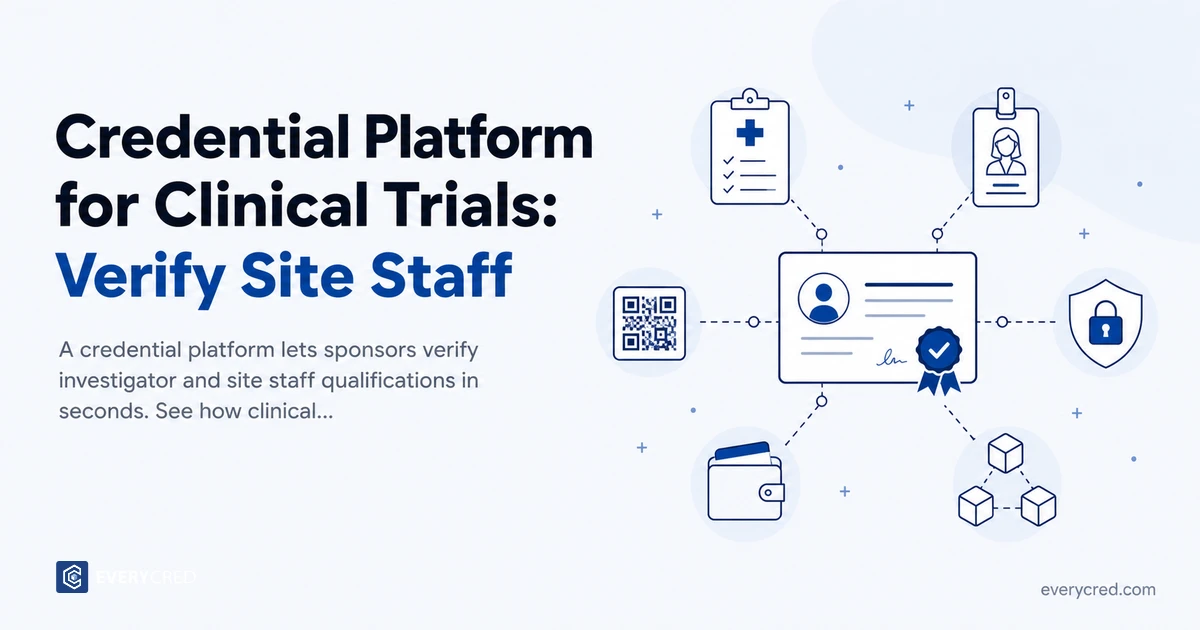
- Why Clinical Trial Credentialing Breaks Down Across Multi-Site Studies
- What Investigator Verification Looks Like on a Credential Platform
- Site Staff Files That Stay Current Between Monitoring Visits
- Audit Findings Shrink When Every Check Leaves a Record
- A Credential Platform Deployment Pattern Proven at Government Scale
- See Trial Site Credentials Verified in Seconds
- Conclusion
- FAQs


A credential platform lets clinical trial sponsors and contract research organizations (CROs) verify every investigator and site staff member in seconds. Cryptographically signed credentials replace a PDF collection with proof that qualifications are authentic and still valid.
Document files cannot make that promise. A scanned license or good clinical practice (GCP) certificate proves a file was uploaded, nothing more.
The gap is expensive. Manual credential checks cost $15 to $25 each and take days to resolve.
Multi-site studies repeat those checks at every activation, protocol amendment, and staff change. When audit findings flag credential gaps, enrollment stalls while quality teams reconstruct records.
This guide covers how clinical trial credentialing works on a verifiable credential platform. It explains who issues each credential, how investigator verification resolves in seconds, and how site staff files stay inspection-ready.
Key Takeaways
- Manual credential checks cost $15 to $25 each; a credential platform verifies for under $0.10 in seconds.
- Cryptographic signatures expose forged licenses and certificates instantly; AI-forged documents grew 311% between Q1 2024 and Q1 2025.
- Revocation registries flag lapsed licenses and expired training at the next scan, keeping site staff files current between monitoring visits.
- Every verification writes to an immutable audit trail, keeping clinical trial credentialing inspection ready without document reconstruction.
Why Clinical Trial Credentialing Breaks Down Across Multi-Site Studies
Every study activation triggers the same collection: investigator CVs, medical licenses, FDA Form 1572, GCP training certificates, and delegation of authority logs. Each item arrives as a PDF, a scan, or a photocopy that cannot prove its own authenticity.
The work repeats for every sponsor, every protocol, and every staff change. An investigator running five studies submits the same file five times. Quality teams then track thousands of expiration dates in spreadsheets that become outdated between monitoring visits.
Sponsors carry the risk either way. FDA Form 1572 records the investigator’s commitments, but sponsors must still demonstrate they selected qualified sites and maintained oversight.
Repetition is why clinical trial credentialing consumes budget without producing assurance. Similar gaps run across healthcare credentials wherever qualifications are manually checked. Each check verifies a document, not the qualification behind it.
What Investigator Verification Looks Like on a Credential Platform
A credential platform replaces document review with cryptographic proof. Three roles interact. An issuer, such as a licensing board or training provider, signs each credential. The investigator holds it in a secure wallet, and any authorized verifier confirms the signature in milliseconds.
Open standards make the proof portable. Credential formats follow the W3C Verifiable Credentials Data Model 2.0, so any compliant system can verify them. Any alteration breaks the signature, and a doctored license or edited certificate fails investigator verification immediately.
Status stays live after issuance. When a medical license lapses or a sponsor withdraws delegation, the issuer revokes the credential in seconds. Every later scan returns it as invalid, including copies already saved in the wallet.
Selective disclosure protects personal data during investigator verification. Zero-knowledge proofs let an investigator confirm an active license and current training without exposing unrelated personal information.
Site Staff Files That Stay Current Between Monitoring Visits
Site staff churn is constant. Coordinators change roles, sub-investigators join mid-study, and GCP certificates expire on rolling dates. A credential file that was complete at activation falls out of date within months.
Signed credentials keep the file current. Training providers issue GCP completion as training program credentials with expiration built into the credential itself. An expired certificate changes status automatically, and the staff member renews it before the gap reaches a monitoring report.
License checks follow the same pattern. Instead of quarterly manual lookups, sponsors run automated license verification against credentials signed by issuing authorities. A suspended license surfaces at the next scan, not at the next audit.
Verification also works where site connectivity does not. A monitor scans a QR code and validates cached cryptographic signatures with no network connection. EveryCRED deployed this offline capability operationally for government field staff in 2025, and the delegation of authority becomes checkable at task assignment instead of being reconstructed afterward.
Audit Findings Shrink When Every Check Leaves a Record
Inspection preparation today means reconstructing who verified what, and when, from email threads and shared drives. An immutable audit trail removes that reconstruction. Every issuance, presentation, verification, and revocation writes a time-stamped record that nobody can edit afterward.
That record answers the questions inspectors ask. Sponsors can show a sub-investigator held valid credentials on the date of every delegated task, with audit-ready credentials replacing after-the-fact attestations. ICH E6(R3), adopted in January 2025, raises sponsor oversight expectations, and a provable verification history answers them directly.
Fraud pressure makes the record more valuable. AI-forged documents grew 311% between Q1 2024 and Q1 2025, and a convincing fake certificate now costs under $30 to produce. Cryptographic checks catch what visual review cannot, at under $0.10 per verification.
A Credential Platform Deployment Pattern Proven at Government Scale
The architecture already runs in production. EveryCRED deployed digital officer credentials for Raigad Police in Maharashtra, integrating with national police databases through a REST API. Field verification that took 30 minutes now completes in under 10 seconds.
The pattern transfers to trial networks directly. A credential platform connects to clinical trial management systems, eTMF platforms, and site portals through one REST API. Verifiers keep their current interfaces, with no front-end changes for coordinators or monitors, and bulk issuance lets a sponsor credential an entire site roster at activation.
Timelines run in weeks. The statewide government rollout finished in 36 weeks, with a working pilot by week 20, and a single-study sponsor pilot is a smaller scope with fewer integrations. For identity assurance alignment, US buyers evaluate platforms against NIST SP 800-63-4, finalized in July 2025.
See Trial Site Credentials Verified in Seconds
We deployed digital officer credentials for Raigad Police, cutting administrative overhead by 85% and enabling offline QR verification for field staff. The same credential platform workflow applies to investigator and site staff files. That means bulk issuance at study activation, instant verification at the site, and an immutable record behind every check. Government and academic research organizations can procure through Carahsoft on the NASA SEWP V and ITES-SW2 contract vehicles. Commercial sponsors and CROs work with our team directly. Book a demo to see the issuance and verification workflow live.
Conclusion
Clinical trial credentialing has outgrown document collection. Signed credentials replace that model with one verification method. Investigators verify instantly at activation, site staff status stays live between visits, and every check leaves a time-stamped record.
The practical starting point is narrow. Map the credential types one study requires, typically licenses, GCP training, and delegation records, then pilot on a single active protocol. Connect the credential platform to existing systems through its REST API and expand site by site.
Oversight expectations keep rising while document fraud gets cheaper. Sponsors that adopt verifiable credentials now will answer future audit requests from a verification log rather than a reconstruction project.
FAQs
How does a credential platform verify clinical trial investigators?
It validates cryptographic signatures on licenses, training certificates, and delegation records in seconds, without contacting each issuing organization.
What credentials do site staff need in a clinical trial?
Typical site staff files include medical licenses, CVs, GCP training certificates, financial disclosures, and delegation of authority records.
Can verifiable credentials detect forged GCP certificates?
Yes. Any alteration breaks the credential’s cryptographic signature, so forged or edited certificates fail verification when scanned.
What happens when an investigator’s medical license lapses?
The issuer revokes the credential in seconds, and every subsequent verification returns it as invalid, including stored copies.
How long does a credential platform deployment take for trials?
A single-study pilot runs in weeks; EveryCRED’s comparable statewide government rollout reached a working pilot by week 20.