29th June, 2026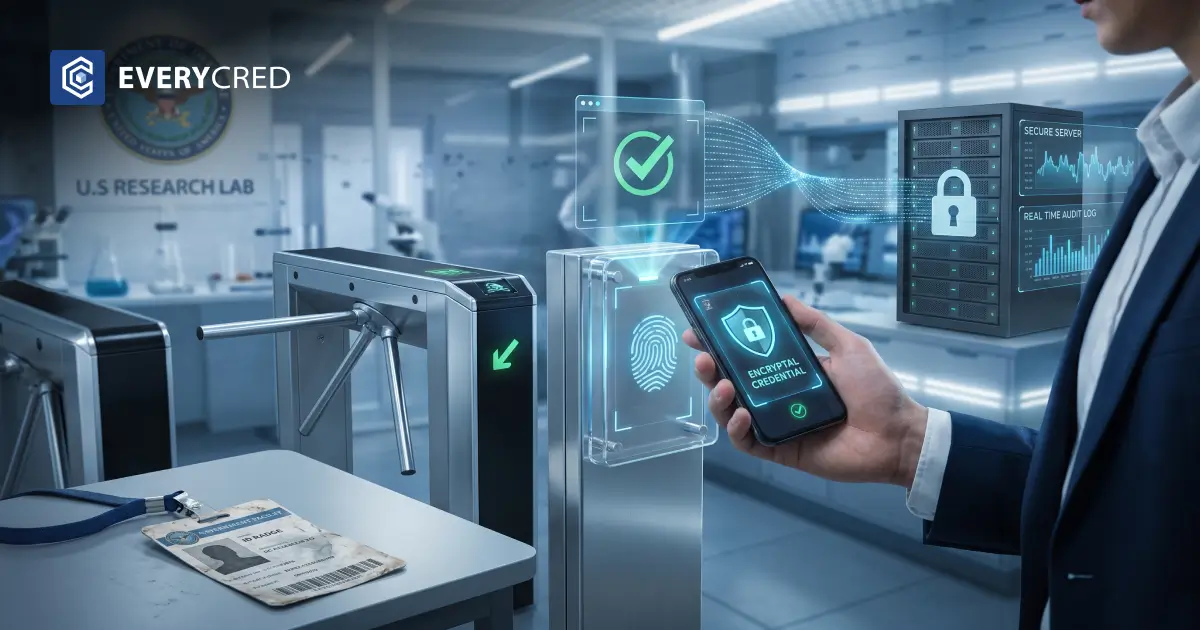
- Why Paper Badges Fail Cleared-Access Programs
- What Digital Credential Software Does for Cleared Personnel Verification
- Facility Access Credentials That Prove Clearance at Entry
- How Digital Credential Software Supports CMMC Access Control
- Deploying Without Disrupting Existing Systems
- How EveryCRED Approaches Cleared-Access Credentialing
- Conclusion
- FAQs


Digital credential software issues, verifies, and revokes cleared-personnel and facility access credentials in seconds. It also records who held which clearance at the moment of entry. For US research labs and defense programs, that record often decides whether an audit passes. Paper badges and spreadsheet rosters cannot prove a subcontractor’s clearance was valid at the door.
This guide serves Facility Security Officers, research program directors, and defense contractor IT leaders. First, it explains what digital credential software does for cleared personnel verification. Next, it shows how the software produces a tamper-evident facility access credential. Finally, it covers how the approach aligns with CMMC access control and NIST identity requirements. Every proof point here comes from live government deployments, not projections.
Key Takeaways
- Digital credential software replaces paper badges with cryptographically signed facility access credentials that prove clearance at the moment of entry.
- Subcontractor rotation across sites is the biggest visibility gap in cleared-access programs. A portable credential closes it.
- Revocation propagates in seconds, so a clearance pulled on Monday cannot pass on Tuesday.
- Every issuance, presentation, and verification writes to an immutable audit trail for CMMC access control and NIST alignment.
- Manual credential checks cost $15 to $25 each. Automated cryptographic verification costs under $0.10.
Why Paper Badges Fail Cleared-Access Programs
Cleared-access programs lose visibility at the subcontractor boundary. A prime contractor verifies its own staff carefully. However, cleared subcontractors rotate across three or four facilities in a single quarter. As a result, nobody can fully account for them.
Consider a research program director named Dana at a federally funded lab. Her prime team is vetted. However, a subcontract electrical crew rotates between her facility and two others, cleared through a different company. Later, auditors asked which crew member held an active clearance during a March access window. Her badge logs showed entry times and a photo. They could not show the clearance status at that timestamp.
That is the core failure. A physical badge proves only that someone received a badge. It does not prove their contractor clearance was active at the time of use. In short, paper and plastic carry no live status.
- Badges stay physically valid after a clearance lapses or is pulled.
- Access logs record entry, not the clearance state behind it.
- Each facility re-verifies the same subcontractor by hand, which adds cost and delay.
Therefore, strong cleared personnel verification must bind the credential to a live, checkable clearance status. That is exactly what digital credential software does.
What Digital Credential Software Does for Cleared Personnel Verification
Digital credential software issues a cryptographically signed credential. That credential carries the holder’s clearance level, sponsoring organization, and validity window. A verifier then checks the signature in seconds and confirms the credential is still active. There is no phone call to a security office. There is no database lookup.
Cleared personnel verification through this model rests on three actions:
- Issue: A security office issues a signed facility access credential to each cleared person, including rotating subcontractors.
- Verify: A guard or reader validates the signature and checks the revocation registry at entry, online or offline.
- Revoke: When a clearance ends, the software revokes the credential in seconds, and every later check then fails.
EveryCRED deployed this same mechanism for the Raigad Police. There, field verification dropped from 30 minutes to under 10 seconds, and administrative overhead fell 85%. The credential type differs, yet the cleared personnel verification logic is identical. In each case, a signed credential drives an instant check and immediate revocation. These government workforce credentials extend the same approach to contractor and subcontractor populations.
Facility Access Credentials That Prove Clearance at Entry
A facility access credential built on verifiable credential standards records a point-in-time fact. It states that this clearance was valid at this timestamp, signed by this authority. Moreover, no one can alter that record later without breaking the cryptographic signature.
This solves Dana’s audit problem directly. When a guard scans the credential at a turnstile, the system logs the clearance status as it stood at that second. Six months later, the facility access credential history answers the auditor’s question. No interpretation or reconstruction is needed.
A facility access credential issued this way also travels. For example, a cleared subcontractor carries one credential that every sponsoring facility can verify against the issuer’s public key. The rotating crew once triggered three separate manual checks. Now it presents one portable facility access credential at each site. Because the check is cryptographic, these are audit-ready credentials with a permanent record at every step.
The result is a facility access credential that proves clearance validity, not just badge possession. For multi-site defense programs, that distinction is the entire point.
How Digital Credential Software Supports CMMC Access Control
CMMC access control practices have two core requirements. First, organizations must limit system and facility access to authorized personnel. Second, they must keep records of that access. Digital credential software supports CMMC access control on both counts. It makes each access decision verifiable, and it logs each decision permanently.
The alignment shows up in three places auditors examine:
- Identification and authentication: Signed credentials meet the assurance intent behind NIST Special Publication 800-63-4, finalized in July 2025. The NIST digital identity guidelines define a framework that legacy badge systems do not fully address.
- Access enforcement: Physical and logical access reference the same credential, so CMMC access control covers the door and the network at once.
- Audit and accountability: Every issuance and verification writes to an immutable audit trail, which gives assessors a tamper-evident record.
As a result, contractor clearance status becomes machine-checkable rather than paper-attested. When a guard verifies a contractor clearance, the system confirms the signature and the live revocation state together. Therefore, a lapsed contractor clearance fails the check automatically. That is exactly the control CMMC access control expects an organization to demonstrate.
Deploying Without Disrupting Existing Systems
Digital credential software does not replace physical access control systems or HR databases. Instead, it adds a credential layer through a REST API. It then reads from the identity sources a program already maintains.
Consider a defense contractor IT lead named Marcus in early 2026. His facility ran an established physical access control system that he could not rip out mid-contract. So he needed integration, not replacement. An API-first credential layer connected to his existing roster. It issued signed credentials to cleared staff and subcontractors. Meanwhile, the turnstiles stayed in place, and verification ran against the new credentials.
Procurement is the other friction point. For US agencies, however, it is solvable. Programs can procure EveryCRED through Carahsoft on existing vehicles, including NASA SEWP V and ITES-SW2. As a result, a program can deploy public sector credentials without a new competitive procurement cycle. Contractor clearance verification then moves from pilot to operation on a defined timeline. Offline verification is also available where facilities restrict network connectivity.
How EveryCRED Approaches Cleared-Access Credentialing
We built EveryCRED as digital credential software for exactly this problem. It issues cryptographically signed credentials, verifies them in under 10 seconds, and revokes them the instant a status changes. In addition, it writes every event to an immutable audit trail. For cleared-personnel access, that means a facility access credential that proves clearance at entry and a contractor clearance that fails the moment a program pulls it. Our platform integrates through REST API with the physical access and HR systems you already run, and it supports offline verification. US research labs and defense programs can procure through NASA SEWP V and ITES-SW2. Request a facility security pilot to see a cleared personnel verification run against your own access scenarios.
Conclusion
Cleared-access programs fail audits for one reason. They can prove a badge was issued, but not that a clearance was valid at entry. Digital credential software closes that gap. It binds each facility access credential to a live, signed clearance status that any sponsoring site can verify in seconds. Because one portable credential travels across facilities, subcontractor rotation stops being a blind spot. Revocation also propagates immediately, so nobody can reuse a pulled contractor clearance. Finally, every event writes to a tamper-evident record, so the system that controls the door also satisfies CMMC access control and NIST audit expectations. In short, digital credential software turns access control into provable accountability.
FAQs
What is digital credential software for cleared-personnel access?
It is software that issues, verifies, and revokes cryptographically signed clearance and facility access credentials, recording who held which clearance at entry.
How does digital credential software handle subcontractors who rotate across facilities?
Each subcontractor carries one portable facility access credential that every sponsoring site verifies against the issuer’s public key, ending repeated manual checks.
Can a facility access credential prove clearance status at the exact moment of entry?
Yes. Each verification logs the live clearance status at that timestamp to a tamper-evident record that no one can alter afterward.
How quickly can a contractor’s clearance be revoked?
Revocation propagates in seconds. So a contractor clearance pulled today fails every verification immediately, even on credentials already stored on a device.
Does digital credential software support CMMC access control requirements?
Yes. It supports CMMC access control through verifiable authentication, combined physical and logical access enforcement, and an immutable audit trail of every event.