17th April, 2026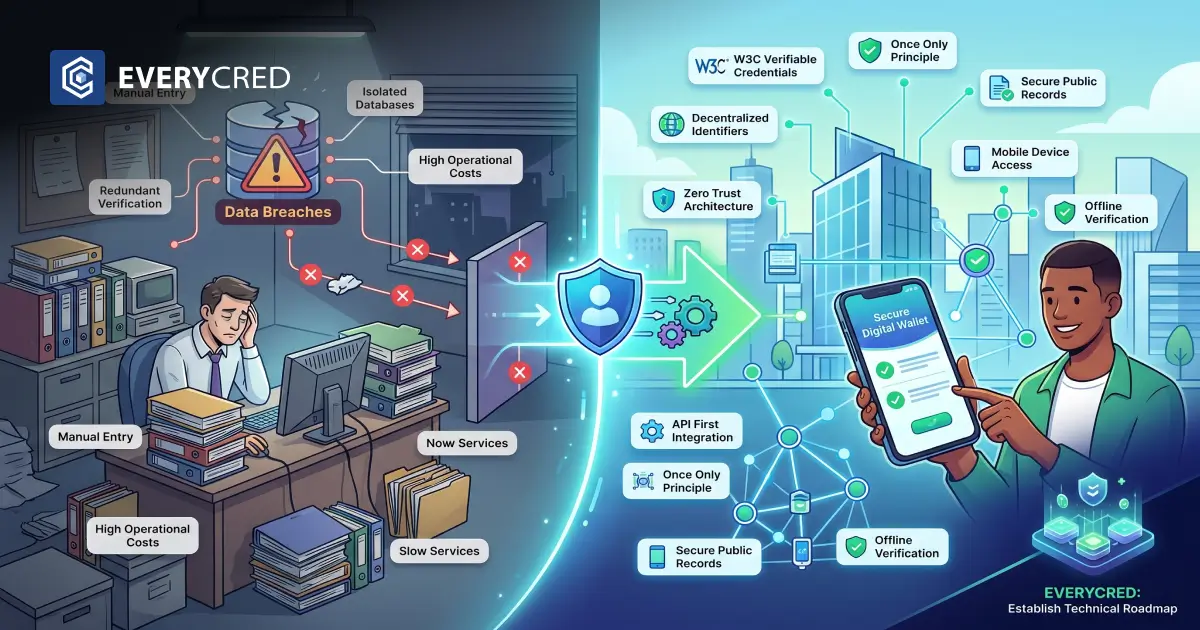
- Outdated Analog Architecture Drains Public Sector Resources
- Verification Standards Shift Toward Decentralized Models
- Blockchain and W3C Standards Secure Public Records
- Agencies Adopt Modern Architectures Without Disrupting Operations
- Mobile Device Integration Enhances Citizen Access
- Upgrade Agency Infrastructure with EveryCRED
- Conclusion
- FAQs


Public sector leaders face immediate requirements to modernize agency operations. Many government departments currently operate on legacy systems. These older systems store data in isolated databases and delay public service delivery. Implementing digital identity infrastructure is a core requirement for digital government transformation. Citizens expect secure and rapid access to public services. Agencies must adopt modern digital government solutions to meet these operational expectations and reduce administrative overhead.
Outdated Analog Architecture Drains Public Sector Resources
Legacy systems rely on centralized databases and paper documents. These older architectures fail to support current administrative demands and create severe operational bottlenecks.
High Operational Costs
- Maintaining legacy infrastructure requires large annual budgets.
- Agencies spend a majority of their IT funds patching outdated software.
- Staff members spend thousands of hours on manual data entry.
- Redundant verification processes increase processing times for citizen requests.
Elevated Security Risks
- Centralized databases create large targets for cyberattacks.
- A single server breach exposes millions of citizen records to unauthorized users.
- Knowledge based authentication fails to stop current credential fraud.
- Federal agencies report that state departments relying on outdated verification suffer massive financial losses during crises. A report from the Pandemic Response Accountability Committee indicates that outdated identity verification methods lead directly to billions of dollars in misdirected government funds.
Increased Citizen Friction
- Citizens submit the identical documents to multiple government departments.
- Processing paper applications takes weeks.
- Replacing manual processes with digital credential software reduces processing delays and provides a faster user experience for the public.
Verification Standards Shift Toward Decentralized Models
Successful digital government transformation requires moving away from isolated databases toward unified digital identities. Modern digital government solutions must prioritize data minimization and direct user control over personal information.
The Once Only Principle
- Modern infrastructure enables citizens to provide their data to a government agency exactly one time.
- Agencies share this verified data across different departments securely.
- Research from Deloitte Insights states that implementing the once only principle reduces citizen friction and cuts administrative costs for public sector organizations.
Zero Trust Architecture
- Agencies authenticate every access request regardless of its origin.
- Digital identities provide the necessary foundation for zero trust access controls.
- Cryptographic keys replace vulnerable passwords to secure government networks.
- Administrators revoke access credentials instantly when security risks appear.
Blockchain and W3C Standards Secure Public Records
Agencies require standardized protocols to ensure different systems communicate securely. Relying on global standards ensures long term viability for digital government solutions.
W3C Verifiable Credentials
- These credentials exist as tamper evident digital files.
- Government issuers cryptographically sign the credentials before distribution.
- Third parties verify the origin and integrity of the document instantly.
- Utilizing verifiable credentials ensures zero tampering of public records and licenses.
Decentralized Identifiers
- Decentralized identifiers remove the requirement for central certificate authorities.
- Citizens hold their verified data locally in secure digital wallets.
- Implementing decentralized identifiers allows individuals to prove their identity without revealing unnecessary personal details to the verifying party.
- The system creates a unique identifier for each specific interaction to prevent tracking.
Agencies Adopt Modern Architectures Without Disrupting Operations
Public sector leaders often delay software upgrades to avoid system downtime. Modern digital government transformation strategies do not require replacing all hardware at once. Effective implementations integrate directly with existing databases.
API First Integration
- Agencies connect new identity verification layers to legacy systems using application programming interfaces.
- This specific approach prevents disruption to daily public services.
- Staff members continue using familiar software interfaces while security upgrades occur in the background.
- Adding an API first platform accelerates deployment timelines for IT departments.
Phased Implementation Strategies
- Agencies start by digitizing a single credential with high usage volume.
- A successful rollout in one department builds the technical framework for wider government adoption.
- IT leaders measure the performance of the initial deployment before scaling the software.
- Evaluating comprehensive digital identity solutions helps public sector leaders map out these phased deployments effectively.
Mobile Device Integration Enhances Citizen Access
Government infrastructure must accommodate users accessing services through mobile devices. Digital identity frameworks support mobile deployments directly.
Secure Digital Wallets
- Citizens download application software to store their government issued credentials.
- The digital wallet secures the data using the biometric hardware of the mobile device.
- Users present their digital credentials in person using QR codes or near field communication protocols.
Offline Verification Capabilities
- Citizens and agencies verify credentials without an active internet connection.
- The cryptographic proof resides within the credential file itself.
- This offline capability ensures government services remain accessible during network outages or in remote locations.
Upgrade Agency Infrastructure with EveryCRED
EveryCRED provides the digital identity infrastructure required for secure public sector operations. Agencies use our platform to issue W3C verifiable credentials and manage EVRC decentralized identifiers. Our API first architecture integrates directly with existing legacy databases.
This ensures agencies upgrade their security protocols without causing operational downtime. Public sector leaders implement our blockchain based digital trust solutions to eliminate credential fraud and accelerate service delivery.
Contact EveryCRED to establish your technical roadmap for identity modernization.
Conclusion
Digital government transformation requires secure and modernized infrastructure. Agencies must adopt secure digital government solutions to protect public data and streamline administrative services. Implementing digital identity infrastructure achieves these specific operational goals. By utilizing verifiable credentials and decentralized identifiers, public sector leaders ensure secure, efficient, and reliable government operations.
FAQs
What is digital government transformation?
It is the modernization of public sector operations using digital identity infrastructure to deliver secure services.
Why must governments modernize legacy identity systems?
Legacy systems are fragmented, expensive to maintain, and highly vulnerable to data breaches and credential fraud.
How do verifiable credentials improve public services?
They enable a secure verification ecosystem, eliminating redundant paperwork and dramatically accelerating public service delivery times.
What role does blockchain play in digital government?
Blockchain creates a decentralized, tamper proof ledger, ensuring digital public records and credentials remain completely secure.
How can agencies adopt digital identity solutions?
Agencies use API first decentralized identity platforms to upgrade security without replacing existing legacy infrastructure completely.