8th June, 2026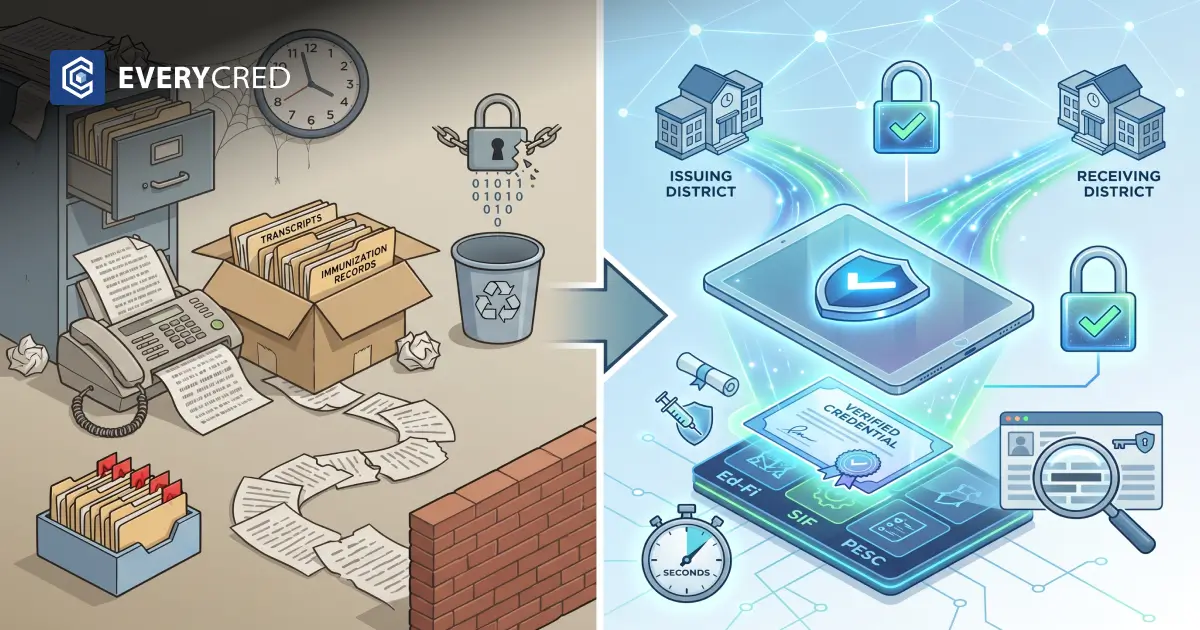
- Why Paper and PDF Student Records Fail FERPA
- What Verified Credentials Change for K-12 Transcripts and Immunization Records
- Verified Credentials Work With Ed-Fi, SIF, and PESC
- The District Playbook: Pilot to Statewide in 36 Weeks
- Build a FERPA Audit Trail for Every Record Exchange
- How We Help Districts Deploy Verified Credentials
- Conclusion
- FAQs


Verified credentials let K-12 school districts issue transcripts and immunization records that a receiving district can confirm in seconds, without phoning the sending office or exposing FERPA-protected data in transit. A verified credential is a cryptographically signed student record that proves its own authenticity. The receiving registrar checks the signature, not the sending district.
Most districts still move these records by paper, fax, and email PDF. That process is slow, and it leaks protected data at every hop. This playbook shows district registrars, superintendents, and state K-12 CIOs how to modernize transcript and immunization record exchange using verified credentials, step by step, from pilot to statewide rollout.
Key Takeaways
– Verified credentials confirm a student transcript or immunization record cryptographically, with no call back to the issuing district.
– Schools and colleges have logged 3,713 data breaches since 2005, exposing 37.6 million records, much of it from paper and PDF handling.
– Verified credentials add a trust layer on top of Ed-Fi, SIF, and PESC student data exchange standards rather than replacing them.
– Selective disclosure shares only the fields a receiving school needs, meeting FERPA data minimization expectations.
– A statewide rollout follows a 36-week model, with a district pilot operational by week 20.
Why Paper and PDF Student Records Fail FERPA
Paper transcripts and emailed PDFs create a FERPA exposure point at every transfer. Records sit in inboxes, print trays, and recycling bins. According to the U.S. Department of Education’s guidance on data breaches, schools remain a frequent target, and improper disposal of physical records is a recurring violation pattern.
The numbers are large. Schools and colleges have experienced 3,713 data breaches since 2005, exposing at least 37.6 million records. Reported education cyber incidents rose 30% between 2022 and 2023.
Consider a common scenario. A registrar named Dana at a mid-size district processes 4,000 transcript and immunization record requests a year. When a family moves districts in October, Dana faxes a transcript and mails an immunization printout. The receiving school cannot confirm either is authentic, so a staff member calls back to verify. The student waits days for correct grade placement while protected data sits in two fax machines and an unsecured inbox.
High student mobility makes this worse. Research links large inbound transfer volumes to placement errors and depressed test performance. Manual transcript and immunization record handling is the bottleneck.
What Verified Credentials Change for K-12 Transcripts and Immunization Records
A verified credential is a cryptographically signed digital record that proves a claim about a student. The issuing district signs it with a private key. Any party can confirm authenticity using the public key, without contacting the issuer or querying a shared database.
Applied to student data exchange, this changes three things:
- Authenticity travels with the record. A transcript carries its own proof. The receiving registrar verifies the signature in seconds, so no callback is needed.
- Tampering is detectable. Any change to a transcript or immunization record breaks the signature, and verification fails automatically.
- Selective disclosure protects FERPA data. A receiving school can confirm immunization compliance or a course completion without receiving the student’s entire file. Sharing only required fields aligns with FERPA data minimization.
This is the holder model in practice. The student or guardian holds the credential, the district issues it, and the next school verifies it. The same approach already underpins academic credential verification at the higher education level. K-12 transcripts and immunization records fit the same pattern.
Verified Credentials Work With Ed-Fi, SIF, and PESC
Student data exchange standards already move K-12 data between systems. Ed-Fi structures transcript and assessment data. SIF, published by A4L, defines a PK-12 interoperability blueprint. PESC standards carry transcripts to postsecondary institutions and crosswalk to SIF.
These standards solve the format. They do not solve trust. A record can be perfectly structured and still be unverifiable, because the receiving system has no cryptographic way to confirm that the sending district actually issued it or that nobody altered it in transit.
Verified credentials add that missing trust layer. The Ed-Fi or SIF pipeline still moves the data. The verified credential proves the data is authentic and unmodified. Districts keep their existing student information systems and interoperability investments. They add credential issuance and verification through an API, with no rip-and-replace.
This distinction matters for state K-12 CIOs evaluating cross-agency verification across district lines. Interoperability standards and verified credentials are complementary, not competing, choices.
The District Playbook: Pilot to Statewide in 36 Weeks
A verified credentials rollout for transcripts and immunization records follows a defined sequence. The model below reaches a working pilot by week 20 and statewide coverage by week 36.
- Scope the records. Select two credential types to start: the official transcript and the immunization record. These carry the highest request volume and the highest FERPA risk.
- Issue credentials from the system of record. Connect the student information system through a REST API. Issue verified credentials in batches, so a full grade cohort receives records at once through bulk issuance.
- Enable verification for receiving schools. Give registrars a verifier tool. A receiving district confirms a transcript or immunization record by scanning a QR code, with results in seconds and no callback.
- Add offline and selective disclosure. Support offline credential verification for schools with limited connectivity, and configure selective disclosure so health services coordinators see only immunization status.
- Run the pilot, then scale. Operate the pilot in one district through week 20, measure verification time and error rates, then extend to the remaining districts by week 36.
Picture a state student information director named Marcus running this. In the pilot district, transcript verification that once took three days of phone tag now resolves during enrollment intake. Immunization compliance checks that required manual re-keying become a single scan. By week 36, every district in the state exchanges the same two verified credentials the same way.
Build a FERPA Audit Trail for Every Record Exchange
FERPA requires districts to track who accessed a student record and when. Paper and email leave that question unanswered. A verified credentials system logs every issuance and verification event to a permanent record.
Each time a receiving school verifies a transcript or immunization record, the platform records the verifier, the timestamp, and the result. That log gives registrars and state K-12 CIOs audit-ready credentials for compliance reviews, with no manual record-keeping.
The same audit trail supports consent. The student or guardian holds the credential and approves each share. So the district can show exactly which records moved, to whom, and with whose consent. That evidence matters when a FERPA complaint or a state audit asks for proof.
How We Help Districts Deploy Verified Credentials
We issue tamper-proof verified credentials that integrate with existing student information systems through a REST API, with no front-end changes for registrars. Districts can verify a transcript or immunization record offline, in seconds, using QR scanning. Our deployment experience includes government rollouts where verification time dropped from 30 minutes to under 10 seconds and administrative overhead fell 85%, evidence that the platform performs at public sector scale. US districts can procure through existing vehicles, including Dallas ISD / Region 4 and the Clark County School District contract. Request a district pilot to see the transcript and immunization record exchange running live.
Conclusion
Paper and PDF student records are slow to move and easy to expose, and they put FERPA-protected data at risk at every transfer. Verified credentials fix the problem at the source. The receiving district confirms a transcript or immunization record cryptographically, in seconds, without a callback or a shared database.
The approach respects existing investments. It layers trust on top of Ed-Fi, SIF, and PESC student data exchange standards rather than replacing them. Districts can start with two high-volume record types, reach a pilot by week 20, and scale statewide by week 36. For superintendents, registrars, and state K-12 CIOs, verified credentials turn record exchange from a liability into a measurable, auditable process.
FAQs
What are verified credentials for student records?
Verified credentials are cryptographically signed student records, like transcripts, that any school can confirm as authentic in seconds without contacting the issuer.
How do verified credentials help K-12 transcripts comply with FERPA?
They use selective disclosure to share only required fields and prove authenticity without exposing the full student file, reducing FERPA data exposure during exchange.
Can verified credentials work with Ed-Fi or SIF student data exchange?
Yes, verified credentials add a trust layer on top of Ed-Fi, SIF, and PESC pipelines, proving authenticity while existing standards continue moving the data.
How are immunization records issued as verified credentials?
A district or health source issues the immunization record as a signed credential, which receiving schools verify instantly during enrollment without manual re-checking.
How long does a district-verified credentials rollout take?
A typical rollout reaches a working pilot by week 20 and statewide coverage by week 36, starting with transcripts and immunization records.